


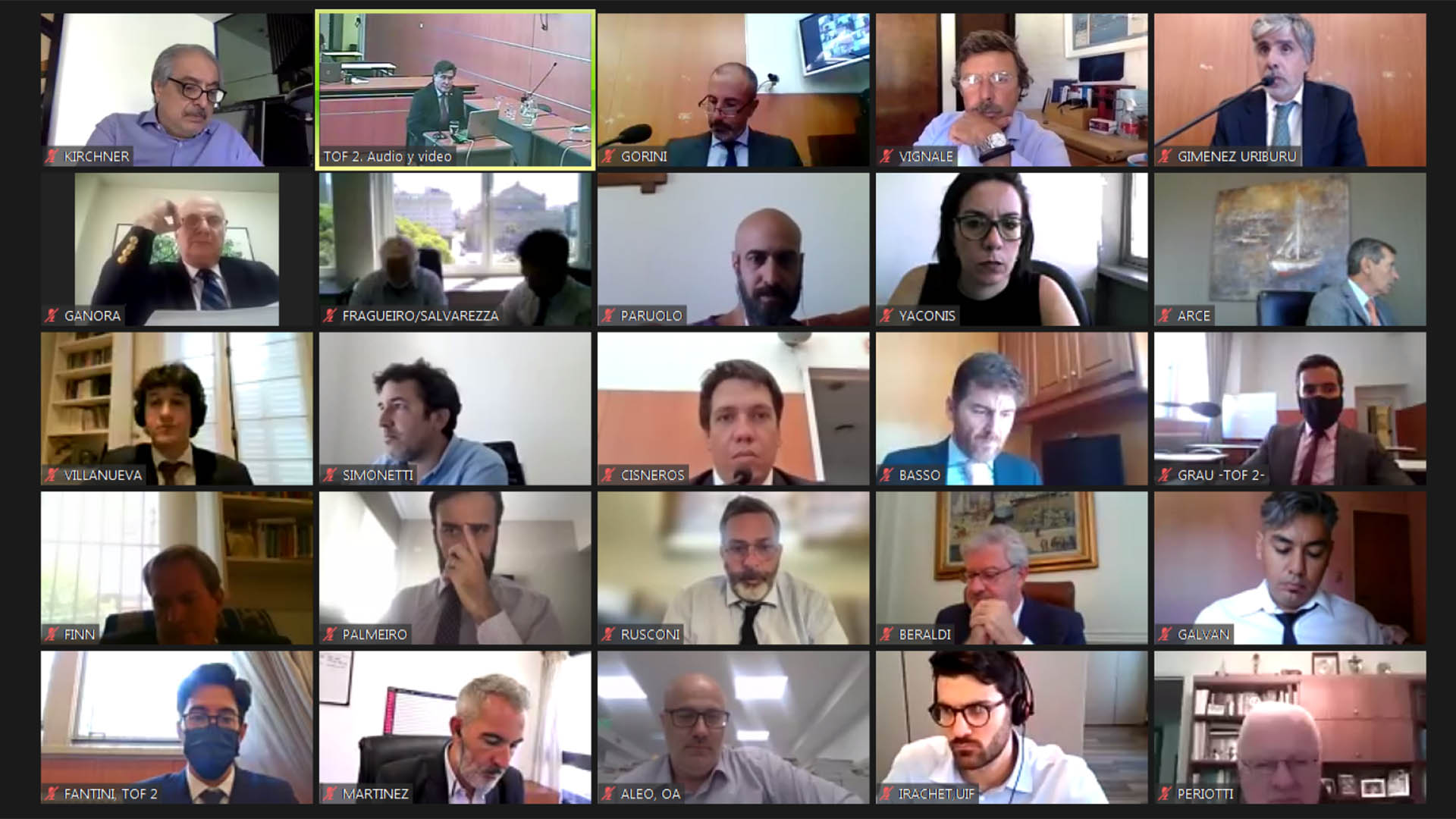
Javier Iguacel, former director of National Highways during the Mauricio Macri government and current mayor of the town of Buenos Aires Capitan Sarmiento, testified today as a witness in the oral trial for the alleged irregularities in public works that businessman Lázaro Báez received during the governments of Néstor and Cristina Kirchner.
Iguacel said that companies in Baez had 80% of the works for Santa Cruz and that half were not finished even though they had all been paid for, unlike other companies.
“Going to testify to Comodoro Py for the Road Case. Always with the truth and with the evidence that showed us that there was an offence,” Iguacel published on his account on the social network Twitter. At 9:30 he began his statement before Federal Oral Court 2.
Iguacel, engineer and first director of National Roads in the Macri government, began by recounting how they began to investigate the irregularities in the Baez works, which later led to the criminal complaint of this oral trial.
He said that when they took office in December 2015, they learned that in Santa Cruz there were road cuts for some 1,500 employees of companies in Baez who were demanding payment of salaries. He said that National Highway owed $1 billion to different contractors. “In the highway corridors there were more managers or business owners who wanted to see me to get paid than highway employees,” said Iguacel.
Thus, they began to analyze what was happening with the works in Santa Cruz. And Iguacel said that the companies in Báez had collected all the works and that despite that they fired and did not pay employees. “Not only was he not owed, but he had been paid in advance,” he said, and that other companies also had delays in payments but had not fired staff. “It was a deliberate decision by the company not to continue,” he said of Baez's decision.
“The companies in Baez had 80 percent of the works in Santa Cruz. Fifty percent of these works were not finished but in total volume 75 percent had not been completed. And there were works from 2006, 2008,” said Iguacel. The mayor decided to travel to Santa Cruz and intervened in the district of Santa Cruz de Vialidad Nacional. Its boss was Mauricio Colladera, one of the 13 accused in the trial.
“I met with Colladera and he told me that he was close to Baez, that I had met him before taking over to Vialidad,” said Iguacel. He also said that during that visit he found that the district of Santa Cruz did not have engineers who could make certifications, there was no control structure.
Iguacel differentiated the situation of companies in Baez with other companies: “There were works companies that had abandoned or suspended works in other jurisdictions but they all had a correlate with non-payment of Roadways. And the companies had warned that they could not continue. That didn't happen with the ones in Baez who had collected everything.”
The former head of Roads also committed two other officials who are not being tried but were raised to oral trial in what will be the second trial for public works. These are Sergio Passacantando, former manager of National Road Administration, and Sandro Fergola, former deputy administrator of National Roads.
Iguacel said that Passacantando told him that he had been appointed to the post by Néstor Kirchner and that José López, former secretary of public works and one of the defendants in the trial, sent him emails or called him to expedite certain payments he asked for. And de Fergola related that construction entrepreneurs told him that this official was summoning them at the Intercontinental Hotel to tell them how the works were going to be distributed.
The first director of National Roads of the government of Macri, was the one who filed the criminal complaint in 2016, whereby the 13 accused, including Báez, the Vice President of the Nation, Cristina Kirchner, the former Minister of Federal Planning Julio De Vido, the former Secretary of Works Public José López, among others.
In the case, the alleged irregularities in the 51 public works that Baez companies received for Santa Cruz from 2003 to 2015, during the three governments of Néstor and Cristina Kichner, are judged. The defendants are 13, including Cristina Kirchner, Baez, López and former Federal Planning Minister Julio De Vido.
As Infobae revealed last week, TOF 2 judges Jorge Gorini, Rodrigo Giménez Uriburu and Andrés Basso want the trial to end before the end of the year to remove the verdict of any speculation before 2023, when the presidential elections in the country take place.
For that they took some measures. One is to add one more hearing to the trial. Today the process is done every Tuesday and every other Monday. But for April it will also be done every Monday and not every other week. That will happen when Judge Basso completes two trials - one against humanity and the other for drug trafficking - that he is conducting as a member of a federal oral court in La Plata. This is expected to happen by the end of March.
The magistrates also analyze that there will be one more hearing at the stage of pleadings and for that moment a special organization is being considered: setting time limits for each of the parties, as established by the Code of Criminal Procedure.
At the time of the experts' statements, the judges also intend not to summon them separately - each one in a hearing - but all together in a kind of colloquium.
I KEPT READING:
Últimas Noticias
Debanhi Escobar: they secured the motel where she was found lifeless in a cistern
Members of the Specialized Prosecutor's Office in Nuevo León secured the Nueva Castilla Motel as part of the investigations into the case

The oldest person in the world died at the age of 119
Kane Tanaka lived in Japan. She was born six months earlier than George Orwell, the same year that the Wright brothers first flew, and Marie Curie became the first woman to win a Nobel Prize

Macabre find in CDMX: they left a body bagged and tied in a taxi
The body was left in the back seats of the car. It was covered with black bags and tied with industrial tape

The eagles of America will face Manchester City in a duel of legends. Here are the details
The top Mexican football champion will play a match with Pep Guardiola's squad in the Lone Star Cup

Why is it good to bring dogs out to know the world when they are puppies
A so-called protection against the spread of diseases threatens the integral development of dogs


