


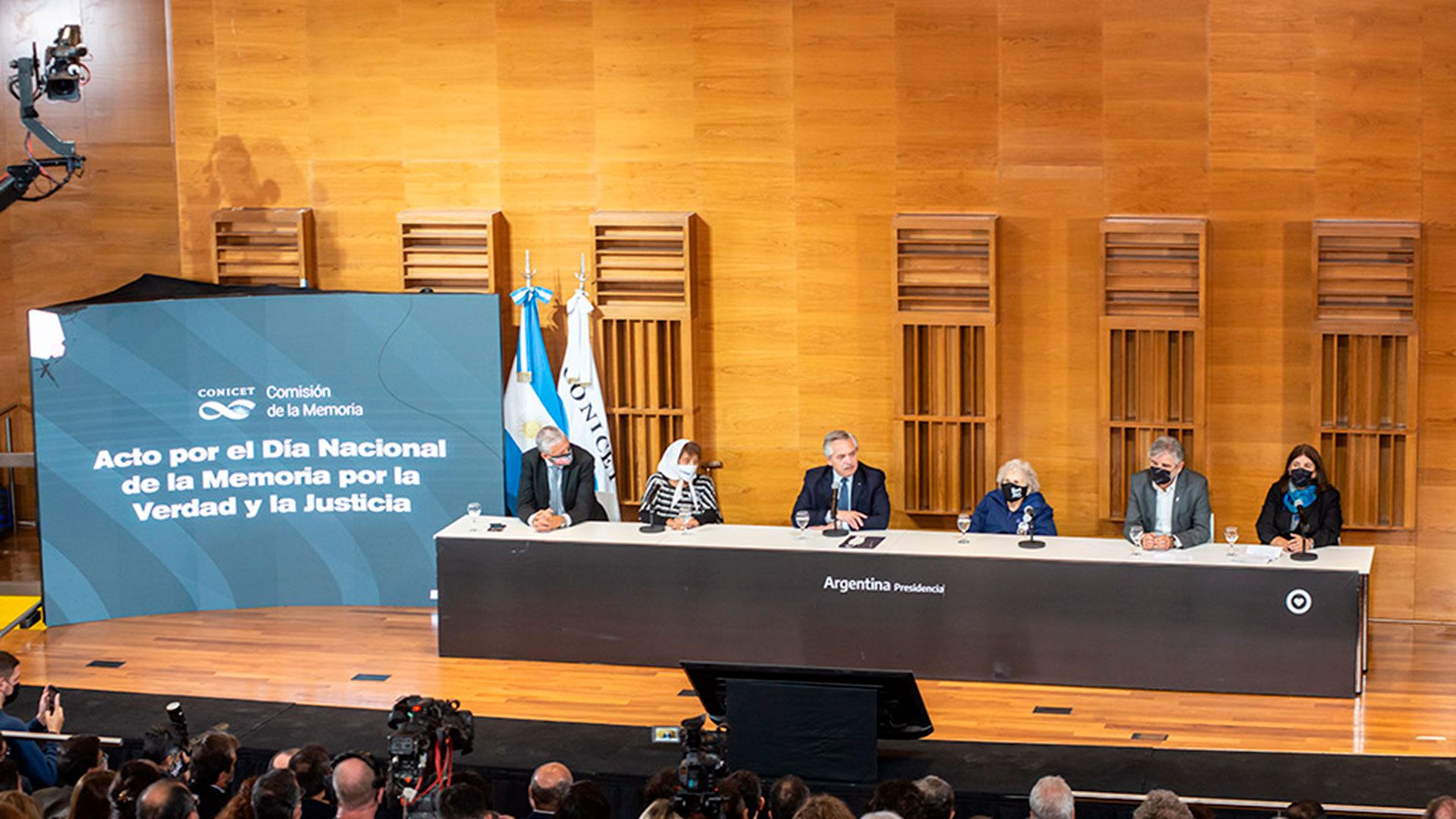
As part of the National Day of Memory for Truth and Justice, the National Council for Scientific and Technical Research (CONICET) reconstructed, for the first, the history and information of the files of eight members of the agency victims of State terrorism, which were handed over to relatives and relatives.
“Following and systematizing some pioneering work, the commission set out to rebuild the processes that violently led so many colleagues into exile, to interrupt, postpone or abandon training and research work, to devastate so many lives, so many teams and institutions,” said the President of CONICET, Ana Franchi; during the event held at the Cultural Center of Science (C3).
The ceremony where these files were delivered were attended by the President of the Nation, Alberto Fernández; the Minister of Science and Technology, Daniel Filmus; and Horacio Pietragalla Corti, head of the Human Rights Secretariat; as well as members of the Board of CONICET, national ministers and ministers, directors of the CONICET from all over the country, authorities and representatives of national universities and science and technology organizations, and human rights referents.
The 8 scientists whose files were rebuilt and repaired are:
- Dante Guede, member of the Support Personnel Career (CPA) at the Argentine Institute of Radio Astronomy (IAR).
- Alicia Cardoso, CPA of the Institute of Astronomy and Space Physics (IAFE).
- Liliana Galletti, fellow at the Faculty of Humanities of the National University of La Plata (UNLP) -
- Mario Oreste Galuppo, scholarship holder at the National Technological University (UTN) Rosario.
- Federico Gerardo Ludden, Fellow of the Faculty of Exact Sciences of the UNLP.
- Martín Toursarkissian, researcher at the Argentine Museum of Natural Sciences “Bernardino Rivadavia” (MACN).
- Manuel Ramón Saavedra, librarian at MACN.
- Roberto Luis López Avramo, CPA at the “Ángel H. Roffo” Institute of Oncology.

The ceremony also recognized those “dismissed, exonerated, exiled, discharged and who were prevented by the military government from continuing their investigations”. As they explained, this event “was held not only to remember those who were killed or disappeared, but also to remedy other damages and injustices of which CONICET workers and investigators were also victims”, in addition to “assuming responsibility to all those who were were harmed and mistreated by state violence during the dictatorship: those who were dismissed, dismissed or exonerated; those who were imprisoned or had to go into internal or external exile; who because of that persecution could not meet the administrative requirements for retirement; or who could not complete their scholarships, projects or tasks”.
According to the technical report presented by the CONICET Memory Committee, reviews of all the agency's resolutions were carried out between 1976 and 1983. It presented the reconstruction of eight biographies and memoirs of missing workers of the Council, although they clarified that “there were hundreds of cases in which the agency's agents had to self-expel or self-exile or the agency took explicit expulsion measures for them”. “The figures are still preliminary, as the Commission continues to work to confirm exactly how many people were the victims of State terrorism in the agency,” they warned.
The words of those present
“CONICET assumes its historical responsibility for what happened and pledges to fight to ensure that violence and persecution never again occur. It is our deepest feeling, it is our ethical stance for truth and justice, it is our political commitment to continue building a democratic body that, through scientific and technological research, contributes to the human rights of all. Now, and always,” said Franchi.
Meanwhile, Alberto Fernández pointed out that the dictatorship “took the life of everything opposed to it.” “Dictatorships had something in common: they were afraid of nothing more than thought, nothing was more dangerous,” said the President, adding: “March 24 is the day we are most united because we have only one slogan: truth and justice.”
Filmus, meanwhile, highlighted CONICET's work and reflected: “An institution that hadn't looked at itself and now does. We are proud of the work led by Ana Franchi and her team. You can't cover up the truth. It is the beginning of a journey and we are committed to doing so. I don't want to miss it, as I see Juan Cabandié and Juliana Cassataro, a scientist and daughter of the disappeared who are leading the COVID-19 vaccine, that we are proud that our researchers are fighting for life. We will continue to work so that the path of memory, truth and justice comes to fruition. Mothers and Grandmothers and Sons were also in the lead. We say thank you.”
In addition, Taty Almeida, mother of Plaza de Mayo Línea Fundadora, and Lita Boitano, president of Relatives of Disappeared and Detained for Political Reasons, were present, who expressed their excitement with the work done. “Everything is memory, so necessary, that memory that more than once they wanted to erase and never succeeded in any way. There were very few mothers left, very few grandmothers. But we are calm because there is a wonderful youth,” said Almeida.
In the voice of Mario Pecheny, Vice-President for Scientific Affairs of CONICET and member of the Memory Committee, the words of a letter written by the father of one of the scientists recognized during this day were heard. “Mr. Licenciado, I acknowledge receipt of your telegram, in this regard I inform you that my daughter Alicia Graciela was abducted from her home on August 25 by unknown persons, her whereabouts being ignored to date, for this reason, her failure to attend the institute should not be considered as abandoning her job”, recounted and stressed that this document is part of “one of the files we are repairing today, written by hand, dated Buenos Aires October 3, 1977″.
At the end of the event, a plaque was discovered in honor of the eight members of the agency victims of State terrorism on the esplanade of the Scientific Pole. At the same time, an artistic intervention was inaugurated around the slogans “Truth”, “Justice”, “Reparation”, “Memory” and “Never Again”.
The C3 was attended by: Juan Manzur (Chief of Cabinet of Ministers) and the Ministers: Santiago Cafiero (Foreign Affairs, International Trade and Worship); Juan Cabandié (Environment and Sustainable Development); Tristan Bauer (Culture); Juan Zabaleta (Social Development); Jaime Perczyk (Education); Martín Soria (Justice and Human Rights); Carla Vizzotti (Health); Claudio Moroni (Labour, Employment and Social Security); Vilma Ibarra (Legal and Technical Secretariat); Gustavo Béliz (Strategic Issues); in addition to the members of other officials and directors of CONICET, the head of the National Agency for the Promotion of Research, Fernando Peirano; and many other personalities and academic authorities, the scientific community and the university education field.
KEEP READING
Últimas Noticias
Debanhi Escobar: they secured the motel where she was found lifeless in a cistern
Members of the Specialized Prosecutor's Office in Nuevo León secured the Nueva Castilla Motel as part of the investigations into the case

The oldest person in the world died at the age of 119
Kane Tanaka lived in Japan. She was born six months earlier than George Orwell, the same year that the Wright brothers first flew, and Marie Curie became the first woman to win a Nobel Prize

Macabre find in CDMX: they left a body bagged and tied in a taxi
The body was left in the back seats of the car. It was covered with black bags and tied with industrial tape

The eagles of America will face Manchester City in a duel of legends. Here are the details
The top Mexican football champion will play a match with Pep Guardiola's squad in the Lone Star Cup

Why is it good to bring dogs out to know the world when they are puppies
A so-called protection against the spread of diseases threatens the integral development of dogs


