


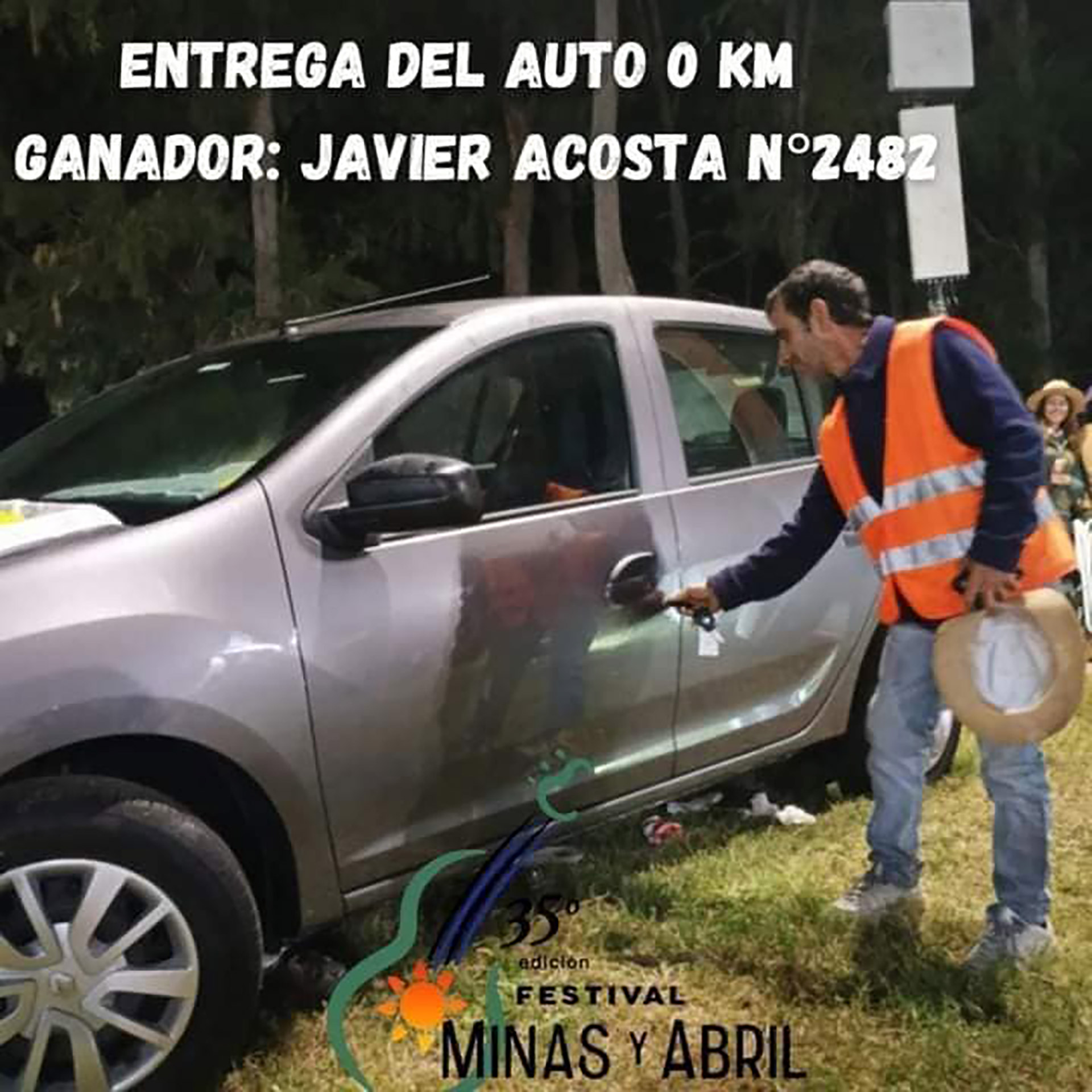
Javier Acosta is a “car caretaker” from the department of Maldonado, in eastern Uruguay. This is what people who take care of cars on the street are called in the country and who are remunerated at the will of the driver when they leave with their vehicle. This man traveled to the city of Minas, in the center of the country, for the 35th edition of the Mines and April Festival, which took place from Friday, April 1 to Sunday, April 3.
In addition to having the shows of several national artists, the festival also experienced a moment of great excitement when Acosta, who had gone to the event to practice as a car care, won a new car in a draw.
The man had bought the raffle number 2,482 and on Sunday night he won a Renault Sandero car. After a girl pulled out of a giant jar a piece of paper with the number that the car caretaker had bought, to the cry of “Olé, olé, Javier”, the man got on stage where they were drawing the numbers to receive his prize in front of the applause of those present.
According to Acosta himself, he attends the festival every year with his brother, who lives in the department of Lavalleja, where the city of Minas is located. “What came to me the most and caused me the most satisfaction of all was the ovation of the people. That was what moved me the most, not so much for the prize; it gave me happiness,” the winner told Underlining.
For more than 20 years, Acosta has been dedicated to caring for cars in different parts of the country, usually where there is more movement because the tips will be higher. For example, at the Bikini Beach Parador, in Punta del Este, it offers valet parking services.
The interview was conducted at the Hospital de Maldonado because his partner was there undergoing a gynecological study to determine the sex of the baby they are expecting. “This one came with a 0 kilometer down his arm,” he said.
Car Care in Uruguay
In Uruguay, a car sitter can earn up to 400 Uruguayan pesos per day (10 US dollars) for working on a block eight hours. In 2019, the Government of Montevideo had around 2,000 informal workers of this type.
In 2017, a study by José María Cabrera and Alejandro Cid on car care in Uruguay was published in the Journal of Economic Analysis. This analysis generated that the policy of formalization by departmental governments exists because, according to the report, it raises the status of the car care as long as the activity begins to be legitimized by the system. However, this does not mean that work ceases to belong to the informal market.
The study warns that granting a right of usufruct, that is to say that one block is assigned to each one, can mean greater job security for the car caregiver. However, formalization requires legal existence in society, because of the basic procedures required to acquire the permit, and in many cases that is a problem because they do not have the documentation up to date.
KEEP READING:
Últimas Noticias
Debanhi Escobar: they secured the motel where she was found lifeless in a cistern
Members of the Specialized Prosecutor's Office in Nuevo León secured the Nueva Castilla Motel as part of the investigations into the case

The oldest person in the world died at the age of 119
Kane Tanaka lived in Japan. She was born six months earlier than George Orwell, the same year that the Wright brothers first flew, and Marie Curie became the first woman to win a Nobel Prize

Macabre find in CDMX: they left a body bagged and tied in a taxi
The body was left in the back seats of the car. It was covered with black bags and tied with industrial tape

The eagles of America will face Manchester City in a duel of legends. Here are the details
The top Mexican football champion will play a match with Pep Guardiola's squad in the Lone Star Cup

Why is it good to bring dogs out to know the world when they are puppies
A so-called protection against the spread of diseases threatens the integral development of dogs


