


The Institute of Social Sciences and Project Disciplines (INSOD) of UADE conducted an online survey to investigate the level of knowledge, beliefs and opinions about the uses that beneficiaries of the Universal Child Allowance (AUH) confer on the money received monthly. In this context, the survey found that for all age groups, most respondents disagreed with the idea that the AUH “helped to improve future opportunities, the health situation or that it helped to maintain schooling for the beneficiaries”.
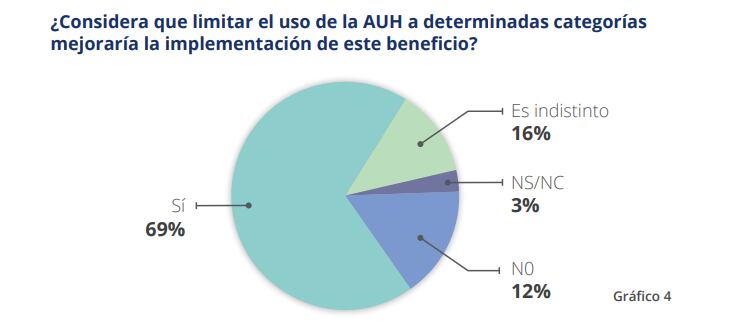
In this context, seven out of ten respondents were of the opinion that restricting the possible uses of AUH would help to optimize the implementation of the provision.
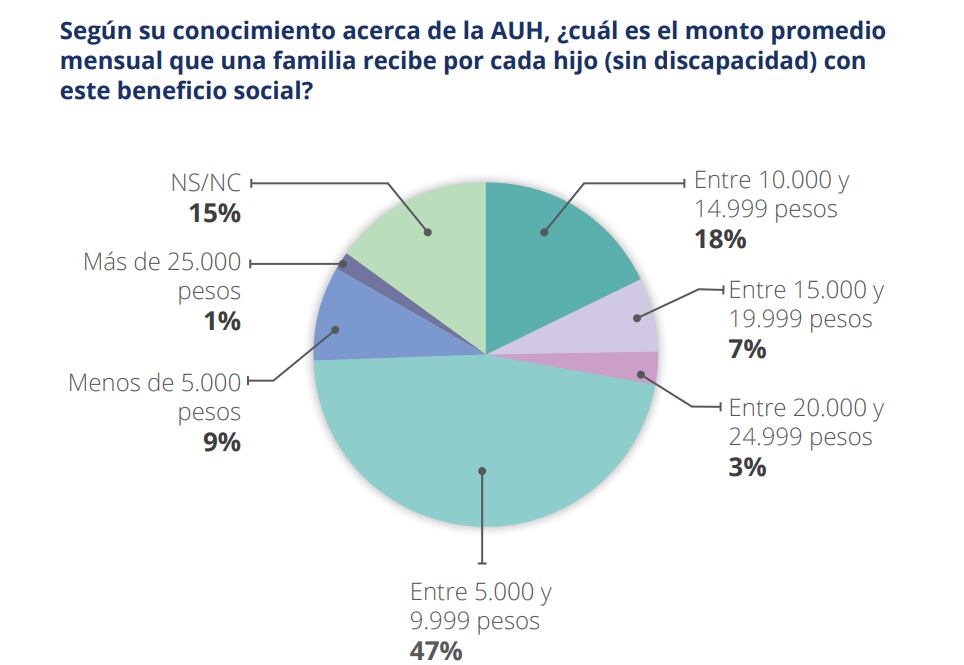
It should be noted that, according to data published by Anses on its website, a family receives $5,677 per month per child (without disabilities), which amounts to $7,381 per month for certain areas of the country. This benefit is paid 100% as long as the family shows schooling and maintaining health (daily vaccination).
In this context, 92% of those surveyed said they disagreed that the money should be used for “Alcoholic beverages, cigarettes and psychoactive substances”, while 71% disagreed with the use of AUH money for “gastronomic outings and shows” (cinemas, theaters, restaurants and bowls).
In addition, nine out of ten respondents agreed that the money received by the AUH should be used for the purchase of food, cleaning supplies and non-alcoholic beverages, as well as for the purchase of school supplies.
Meanwhile, the majority of respondents, 72%, considered that the money is spent by beneficiaries very frequently or always on food, cleaning and non-alcoholic beverages. On the other hand, 68% said that the money is spent very frequently or always on “Alcoholic beverages, cigarettes and psychoactive substances”.
65% of respondents believe that beneficiaries use the AUH for mobile phone and other technology charges very frequently or always.
In the categories Clothing and Footwear and Gastronomic Outings and Shows, beliefs are more balanced. 52% suppose that it is spent on clothing and footwear very frequently (40%) or always (12%). On the other hand, 53% think that gastronomic outings and shows, such as cinemas, theaters or bowls, are rarely frequented (43%) or never (9%).
According to the survey, which was mainly focused on citizens of medium and upper-middle socioeconomic status in the Autonomous City of Buenos Aires and localities in the Buenos Aires suburban area, 47% of respondents know the average value of the AUH, while 29% believe that the perceived value is higher than the real one.
In addition, 9% believe that the value is less than the amount actually received and 15% say they do not know the value of this monthly financial benefit.
After revealing the beliefs about the most frequent uses of the AUH money and, after consulting on the ethical issue of using the social plan in each category, it was investigated into its implementation and possible change.
Should the scope of the AUH be restricted to certain items (the most widely accepted), could there be an improvement in the execution of the benefit? In this regard, 69% of respondents said yes, 16% rated the impact of this modification as “indistinct” and 12% said that limiting the use of AUH to certain categories would not improve the implementation of the benefit.
In the breakdown by age group, there is a considerable difference between the opinions of younger groups (with complete secondary school or incomplete university). These are the ones who were most in favor of the positive impact of limiting the categories of use of the AUH.

Finally, and by way of summary, the survey conducted by UADE consulted the general opinion on the impact of the AUH on the conditions of the beneficiaries. This program was created in 2009 in order to protect families in contexts of social vulnerability, promote schooling, health control, vaccination and the provision of identity documents to all children and adolescents under 18 years of age and older than 18 years with disabilities (AUHD).
62% of respondents strongly disagreed (41%) and somewhat disagreed (21%) that the AUH has improved future opportunities for beneficiaries. Two other categories emerge from this indicator, which follow a similar line. About 58% strongly disagree (35%) or disagree (23%) that the AUH has improved the health status and/or schooling of the beneficiaries.
On the other hand, opinions about the impact of the AUH on the food situation of the beneficiaries are a little more balanced.
KEEP READING:
Últimas Noticias
Debanhi Escobar: they secured the motel where she was found lifeless in a cistern
Members of the Specialized Prosecutor's Office in Nuevo León secured the Nueva Castilla Motel as part of the investigations into the case

The oldest person in the world died at the age of 119
Kane Tanaka lived in Japan. She was born six months earlier than George Orwell, the same year that the Wright brothers first flew, and Marie Curie became the first woman to win a Nobel Prize

Macabre find in CDMX: they left a body bagged and tied in a taxi
The body was left in the back seats of the car. It was covered with black bags and tied with industrial tape

The eagles of America will face Manchester City in a duel of legends. Here are the details
The top Mexican football champion will play a match with Pep Guardiola's squad in the Lone Star Cup

Why is it good to bring dogs out to know the world when they are puppies
A so-called protection against the spread of diseases threatens the integral development of dogs


