


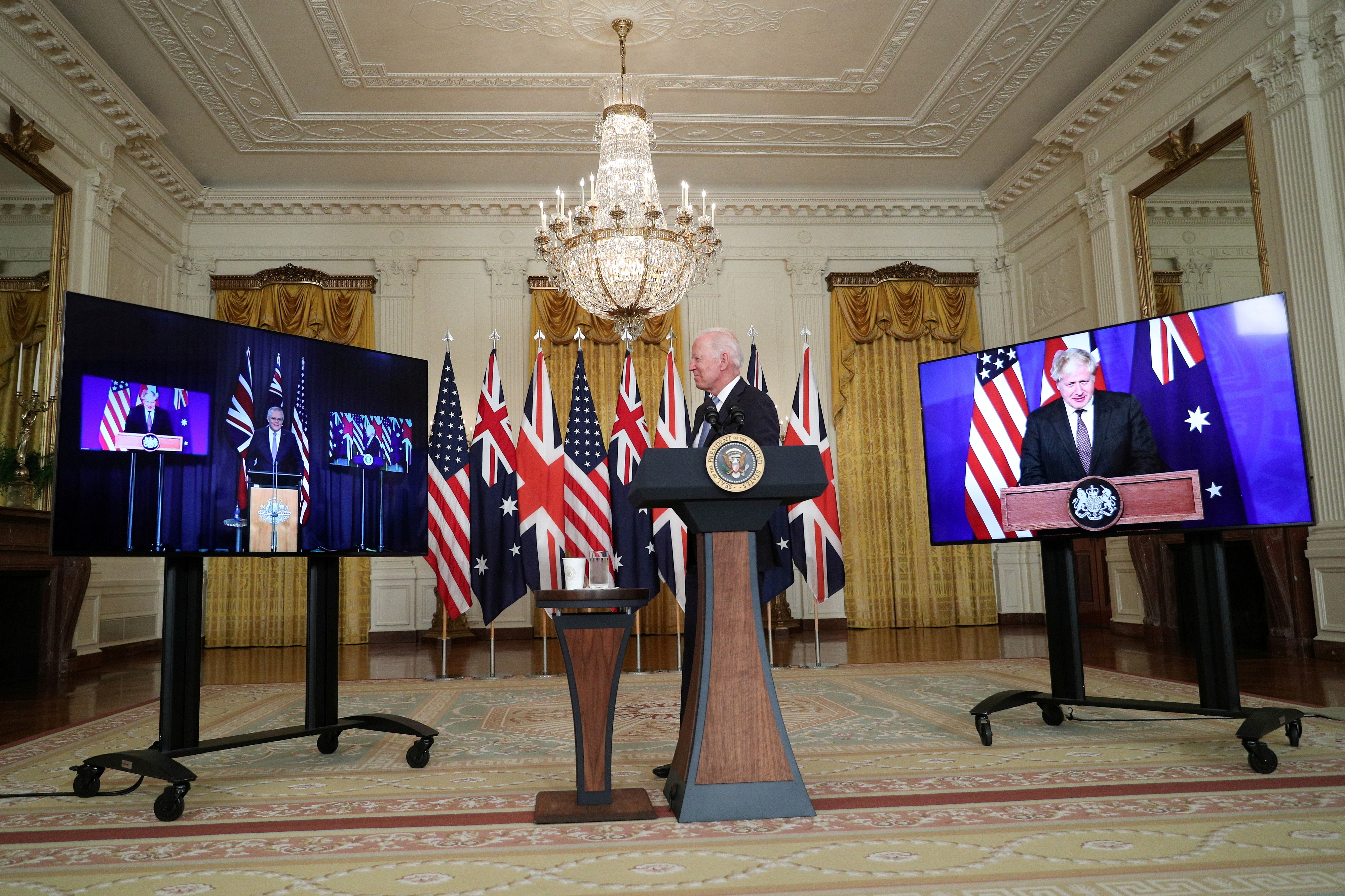
The United States, Britain and Australia said on Tuesday that they will begin collaborating together on hypersonic weapons and “electronic warfare capabilities,” as part of their new AUKUS alliance aimed at countering China.
The three countries said the joint initiatives will reinforce existing efforts to deepen cooperation in numerous areas that they already agreed upon when they formed the new defensive pact last September.
PUBLICIDAD
“We committed today to start a new trilateral cooperation on hypersonic and counter-hypersonic, and electronic warfare capabilities, as well as to expand information exchange and deepen cooperation in defense innovation,” they said in a joint statement.
“These initiatives will add to our existing efforts to deepen cooperation on cyber capabilities, artificial intelligence, quantum technologies and additional underwater capabilities.”
PUBLICIDAD
“As our work progresses in these and other critical defense and security capabilities, we will seek opportunities to engage close allies and partners.”
PUBLICIDAD
Russia, China, the United States and North Korea have launched test hypersonic missiles, and Tuesday's announcement came just weeks after Moscow said it had launched them for the first time in its war in Ukraine.
Hypersonic missiles, like traditional ballistic missiles that can launch nuclear weapons, can fly at more than five times the speed of sound.
PUBLICIDAD
While ballistic missiles fly high in space in an arc to reach their target, a hypersonic weapon flies on a low trajectory in the atmosphere, potentially reaching a target faster.
Crucially, a hypersonic missile is maneuverable, like the much slower cruise missile, often subsonic, which makes it much harder to track and defend.
PUBLICIDAD
Russia is seen as the most advanced nation in this field, while China is also aggressively developing technology, according to the US Congressional Research Service (CRS).
In October, the Chief of the Joint Chiefs of Staff, General Mark Milley, confirmed that China had conducted tests with a hypersonic weapon as part of its effort to develop space and military technologies.
PUBLICIDAD

Milley said in a television interview that the Chinese essay was a “very significant event, the test of a hypersonic weapon, and it is of great concern.”
PUBLICIDAD
The budget requested by the Pentagon for 2023 includes $4.7 billion for research and development of hypersonic weapons. Plans include having a hypersonic missile battery installed by next year, a missile to launch from the sea in 2025 and a cruise missile by 2027.
France, Germany, Australia, India and Japan have been working on hypersonics, and Iran, Israel and South Korea have done basic research on the technology, CRS said earlier.
PUBLICIDAD
The United States, Britain and Australia launched their historic security pact last September, along with Canberra scrapping a multi-million dollar submarine deal with France that angered Paris.
The pact, known as AUKUS, was proclaimed at that time as a pact that allowed the three allies to share advanced technologies.
(With information from AFP and AP)
Keep reading:
PUBLICIDAD
PUBLICIDAD
Últimas Noticias
Debanhi Escobar: they secured the motel where she was found lifeless in a cistern
Members of the Specialized Prosecutor's Office in Nuevo León secured the Nueva Castilla Motel as part of the investigations into the case

The oldest person in the world died at the age of 119
Kane Tanaka lived in Japan. She was born six months earlier than George Orwell, the same year that the Wright brothers first flew, and Marie Curie became the first woman to win a Nobel Prize

Macabre find in CDMX: they left a body bagged and tied in a taxi
The body was left in the back seats of the car. It was covered with black bags and tied with industrial tape

The eagles of America will face Manchester City in a duel of legends. Here are the details
The top Mexican football champion will play a match with Pep Guardiola's squad in the Lone Star Cup

Why is it good to bring dogs out to know the world when they are puppies
A so-called protection against the spread of diseases threatens the integral development of dogs


