

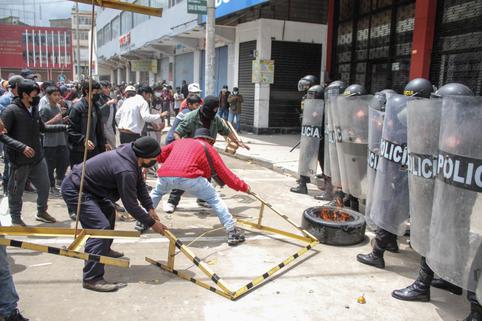
The latest news of the transport strike in Huancayo. The capital of the Junín region woke up amid the uncertainty of what may happen in the next few hours after the intervention of the roads that have caused their partial isolation, so that no one can leave or enter the territory if they are on a means of transport. This organized stoppage has added other groups - such as farmers - who are holding demonstrations for the central government to come to them and are able to provide solutions to the problems they are facing.
In the case of Huancayo, the blockade of the main access roads has led passengers stranded on the runways to make the decision to load their belongings in order to try to escape on foot and arrive at another nearby destination where they can get some kind of mobility that will take them to their final destination. This transport stoppage caused food products and raw materials to be completely lost as they drift for hours, and although police officers have cordoned off the area, there has been no improvement.
LATEST NEWS CHILDBIRTH CARRIERS IN HUANCAYO
The latest reports detail reports of merchants who have been intimidated by carriers into closing their businesses indefinitely to join their demonstrations. These events have caused confrontation between the participants and members of the police.
On the fifth day of the strike in Huancayo, cameras recorded violent acts, with supermarkets and banks being looted. For fear that something will happen to them, the inhabitants have decided to stay in their homes and not put themselves at risk. As a result of these acts, two people were run over in the middle of the wars.
There have also been reports of a shortage of water and a rise in the price of products in the basic family basket. This situation affects not only a large part of the sectors that keep the country's economy active, but also teachers and students who are mostly not attending schools, which opened their doors in March as part of the start of the 2022 school year.
WHAT ARE THE AUTHORITIES DOING?
Through the social networks of the presidency of the Council of Ministers (PCM), the population was informed that the government has arranged for the trip of three ministers of state to Huancayo to start and strengthen dialogue with the city's protesters and thus put an end to the paralyzations.
Roberto Sánchez (Mincetur), Óscar Zea (Agrarian Development) and Alejandro Salas (Culture) are the authorities that will initiate the dialogue with the carriers, who have asked for this communication since the end of 2021.

BACKGROUND
In October 2021, the manager of the National Union of Transporters of Peru, Luis Marcos Bernal, reported that they had meetings with the authorities in order to reach an agreement that would help them solve the problems that have been affecting the proper conduct of their activities. In communication with Exitosa, he explained that there are three main issues for which they are demanding attention:
- Price of diesel, which increased its sales value by 64% from the beginning of the pandemic until the last months of 2021.
- The carrier is assuming the increased cost of fuel in the national territory
- The return of the selective to consumption, that this benefit has become a prejudice, and the increase in the toll.
In the dialogue, he specified that reaching a transport stoppage was a probability, but not the desired thing, since they were committed to the appropriate channels in which the government intervenes for the welfare of this sector.
THE STOPPAGE OF CARRIERS BEGINS ON APRIL 4
“There will be no public transport, tourist transport, taxis, collective cars, motorcycle taxis and, in some regions, river transport. All of them are fighting, they are going to paralyze their activities. Where possible, there will be peaceful marches with which we will mobilize in all parts of Peru,” explained the president of the Union of Multimodal Transport Guilds of Peru (UGTRANM), Geovani Diez.
KEEP READING
Últimas Noticias
Debanhi Escobar: they secured the motel where she was found lifeless in a cistern
Members of the Specialized Prosecutor's Office in Nuevo León secured the Nueva Castilla Motel as part of the investigations into the case

The oldest person in the world died at the age of 119
Kane Tanaka lived in Japan. She was born six months earlier than George Orwell, the same year that the Wright brothers first flew, and Marie Curie became the first woman to win a Nobel Prize

Macabre find in CDMX: they left a body bagged and tied in a taxi
The body was left in the back seats of the car. It was covered with black bags and tied with industrial tape

The eagles of America will face Manchester City in a duel of legends. Here are the details
The top Mexican football champion will play a match with Pep Guardiola's squad in the Lone Star Cup

Why is it good to bring dogs out to know the world when they are puppies
A so-called protection against the spread of diseases threatens the integral development of dogs


