


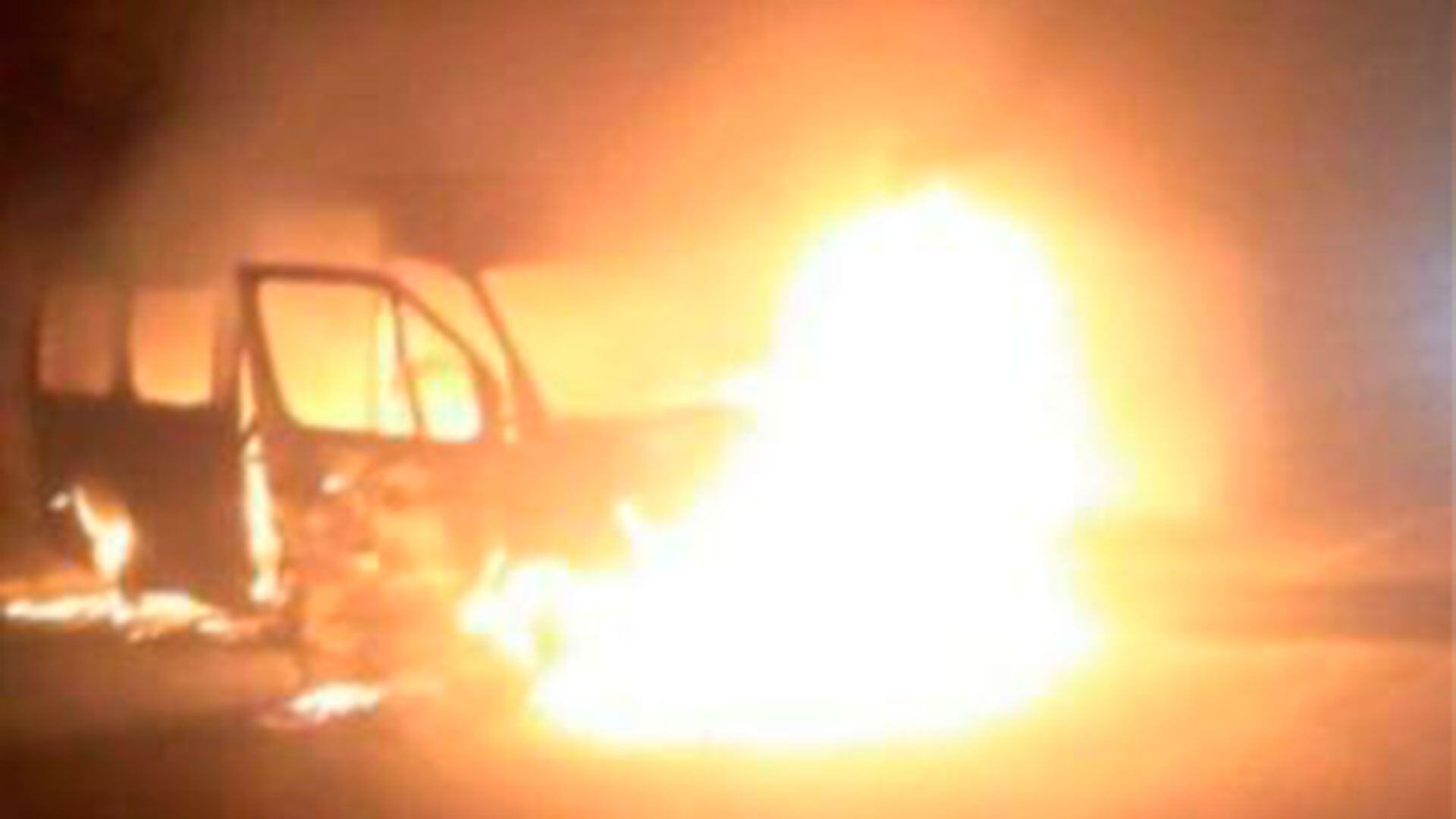
During the early hours of Monday, March 28, hooded men, who were armed, attacked a vehicle, drove the driver down and then proceeded to burn the car, using it to block the route. The attack was awarded by a radical Mapuche group.
A worker of the Serfonac company, which provides services to the Forestal Mininco, which is dedicated to wood production and who has been involved in various conflicts with the burning of machinery inside its farms, because of the Mapuche people's struggle for the restitution of their lands, was attacked by an undetermined group of people.
The incident occurred at approximately six in the morning, where the armed group forced the driver to get out of the vehicle and after the ambush they burned the van, to use it as a blockade on route P-72 at kilometer 17, located on the regional border between Biobío and La Araucania, in southern Chile.
Carabineros arrived at the scene to perform the corresponding examines. Preliminarily, the event was attributed to Weichan Auka Mapu, a radicalized Mapuche group that carry out such attacks for land claims. This is after a pamphlet that they would have left in the place, written in Mapudungun, the Mapuche language.
State of Emergency
This would have been the first attack since the de-escalation of the State of Emergency, which lasted in the area for six months, due to the conflict between the Mapuche people and the Chilean State.
This dispute originates in the 19th century due to the so-called “Pacification of La Araucania”, where territories that, until then, declared themselves autonomous from the Chilean State were occupied than during colonization. In the face of the seizure of property or the Wallmapu of the Mapuche people, the conflict that remains to the present day began.
Considering the acts of violence that occurred in the area due to the radical Mapuche struggle, the previous government of Sebastián Piñera decreed a State of Emergency in the provinces of Arauco, Biobío, Malleco and Cautín, the areas of greatest conflict.
The measure began to take effect on October 13, 2021 and continued until Saturday, March 26. The extension of this mandate was one of the first decisions that the Government of Gabriel Boric had to face, which ended in lowering the State of Emergency. For the de-escalation of the State of Emergency, the president sent a delegation of ministers to the place, which was not without controversy, following the shooting of the Minister of the Interior.
Following the end of the State of Emergency, the Undersecretary of the Interior, Manuel Monsalve, said that “the Government has taken decisions that allow the police to improve the capacities of the police to guarantee the security that all Chileans deserve.” “There are acts of violence in the Araucanía Region and acts of violence in the Biobío Region that generate concern and a sense of insecurity, but I think we have had good dialogues and have given serious records that the government has actually taken decisions that allow the police to improve the capacities of the police to guarantee the security that every Chilean deserves,” said Monsalve.
On the day that the measure ended, the undersecretary said that, “as you already know, President of the Republic Gabriel Boric had committed not to extend this State of Emergency, but that does not mean that the government does not have a concern and does not have the task of guaranteeing the safety of all citizens of Chile and of course those who live in the Araucania region and in the Biobío region, which is where the State of Emergency ends.”
He added that this work was done by the Investigative Police (PDI) and the Carabineros, “therefore, a series of measures have been taken that strengthen the capacities of the police to carry out such an important task in a democracy. We have clearly sought to strengthen staffing, strengthen operational capacities in terms of equipment,” he said.
“This also implies having police strategies that allow us to fulfill the task of ensuring security in the Biobío Region and the Araucania Region.” This will require a discussion with the local authorities on the matter. “There is always concern, it is natural that there is concern,” Monsalve said.
In spite of the foregoing, during the early morning of March 28, there was a new arson attack in the Biobío region. This will be the subject of investigation of the Public Ministry. Until the close of this edition no public authority that has referred to the burning of the van.
KEEP READING
Últimas Noticias
Debanhi Escobar: they secured the motel where she was found lifeless in a cistern
Members of the Specialized Prosecutor's Office in Nuevo León secured the Nueva Castilla Motel as part of the investigations into the case

The oldest person in the world died at the age of 119
Kane Tanaka lived in Japan. She was born six months earlier than George Orwell, the same year that the Wright brothers first flew, and Marie Curie became the first woman to win a Nobel Prize

Macabre find in CDMX: they left a body bagged and tied in a taxi
The body was left in the back seats of the car. It was covered with black bags and tied with industrial tape

The eagles of America will face Manchester City in a duel of legends. Here are the details
The top Mexican football champion will play a match with Pep Guardiola's squad in the Lone Star Cup

Why is it good to bring dogs out to know the world when they are puppies
A so-called protection against the spread of diseases threatens the integral development of dogs


