

Bullfighting and cockfighting were declared as intangible cultural heritage in the state of Nuevo León, after this Monday, April 4, the Legislation Committee of the Local Congress approved amendments to the Cultural Heritage Law so that this type of activity is considered as such.
At the close of the ordinary session, it was determined that the municipalities of the entity will be responsible for granting authorization permits for this type of show to be held, including rodeo, jaripeo, horse racing, cockfighting and bullfighting.
In this way, a period of no more than 90 working days was established for the municipalities of Nuevo León to adapt their regulations in order to comply with this decree.
According to article 18 of the Cultural Heritage Law of the State of Nuevo León, state and municipal authorities “shall refuse permits or authorizations to carry out works on assets attached to cultural heritage”.
The votes in favor were made by five deputies from the National Action Party (PAN) and 5 from the Institutional Revolutionary Party (PRI), while only three votes were obtained against: two from the Citizen Movement (MC) and one from the Labor Party (PT).
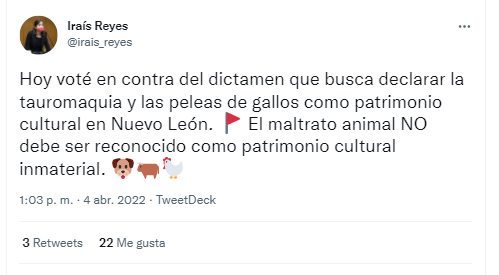
The deputies who spoke out against it were Sandra Pámanes (MC), Anylú Hernández (PT coordinator) and Iraís Reyes (MC), who voted against the ruling since “animal abuse should not be recognized as intangible cultural heritage,” she commented on her Twitter account.
In the same way, some organizations showed their rejection, since these types of activities and shows threaten the integrity of animals. One of them was Adopta Monterrey, which demanded consistency from deputies and deputies to vote against the opinion.
This is based on the argument that bullfighting and cockfighting are “activities that only benefit a handful of entrepreneurs and that do not represent either the NL workforce, nor significant economic inputs. We remind them that violence and the death of a living being is NOT synonymous with fun, much less culture,” they said.
Similarly, the association Unidos por el Bienestar Animal N.L. commented that, if approved, there would be a setback in terms of “ethical treatment” and animal welfare, in addition to the fact that this initiative would amend the State Cultural Heritage Act “which clearly encroaches on animal protection competition that is the responsibility of the Law on Animal Protection and Welfare for Sustainability of the State of NL”.
It should be recalled that in Guanajuato bullfights (like charrería) were declared intangible cultural heritage “because of its historical, cultural and social character”. This initiative was promoted by various Charras and bullfighting institutions, such as the León and Irapuato Bullfighting Centers and the National Association of Matadores.
Other states that have considered this activity as intangible cultural heritage are: Aguascalientes, Hidalgo, Querétaro, Tlaxcala and Zacatecas. On the contrary, the entities where bullfighting festivities are prohibited are Coahuila, Guerrero, Sonora, Quintana Roo and some municipalities in the State of Mexico, Veracruz and Michoacán.
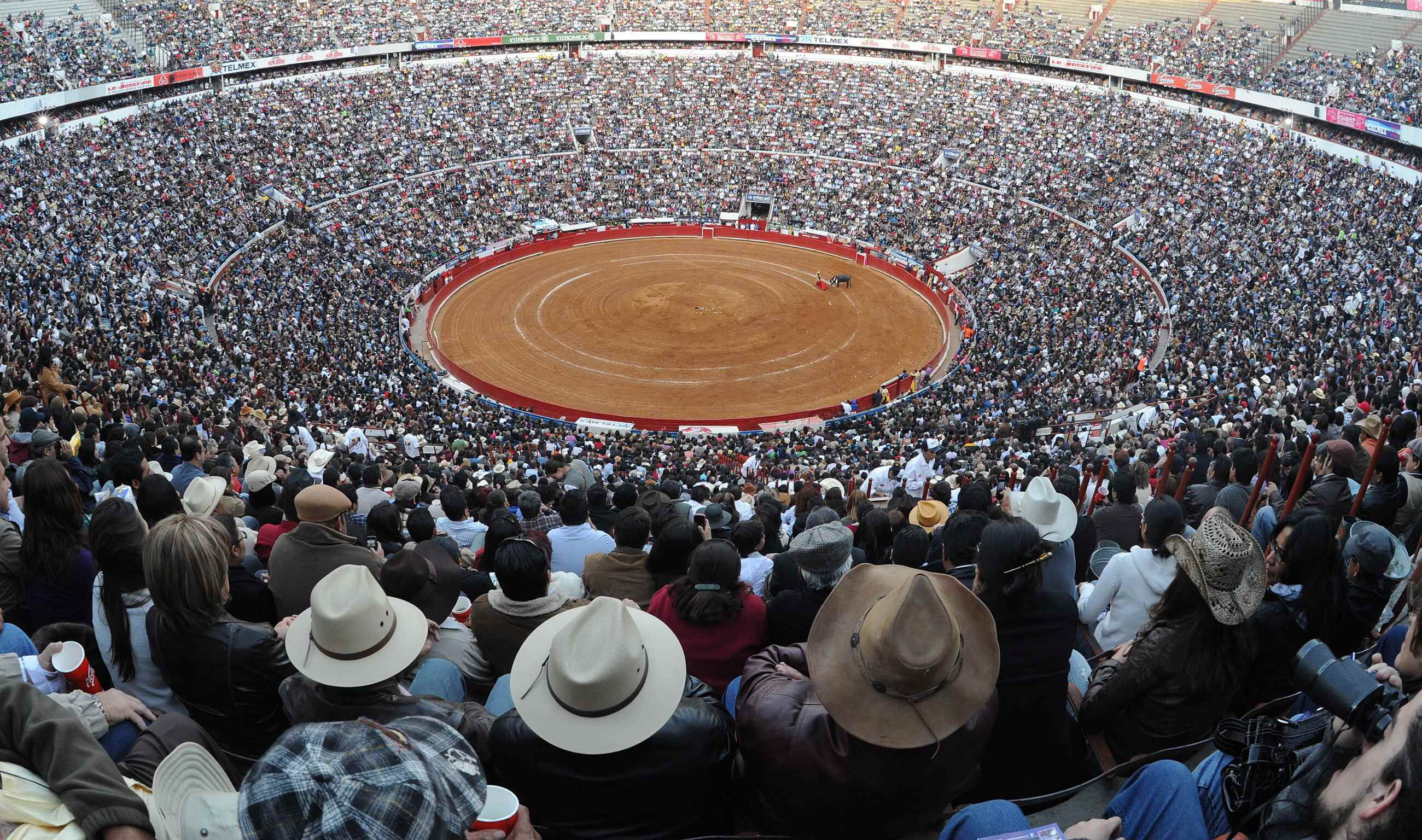
Mexico is currently the second country (the first is Spain) with the highest number of bullrings: 216 active, of which 10 are first category, 7 second and 198 third. In addition, Plaza México is the largest bullfighting venue in Mexico and the one with the largest capacity in the world, with capacity for 46,000 spectators.
KEEP READING:
Últimas Noticias
Debanhi Escobar: they secured the motel where she was found lifeless in a cistern
Members of the Specialized Prosecutor's Office in Nuevo León secured the Nueva Castilla Motel as part of the investigations into the case

The oldest person in the world died at the age of 119
Kane Tanaka lived in Japan. She was born six months earlier than George Orwell, the same year that the Wright brothers first flew, and Marie Curie became the first woman to win a Nobel Prize

Macabre find in CDMX: they left a body bagged and tied in a taxi
The body was left in the back seats of the car. It was covered with black bags and tied with industrial tape

The eagles of America will face Manchester City in a duel of legends. Here are the details
The top Mexican football champion will play a match with Pep Guardiola's squad in the Lone Star Cup

Why is it good to bring dogs out to know the world when they are puppies
A so-called protection against the spread of diseases threatens the integral development of dogs


