


The Venezuelan Government yesterday welcomed the adoption of a resolution submitted by the Non-Aligned Movement to the UN Human Rights Council (HRC), on the “negative impact” of international sanctions on citizens.
The text, adopted on Thursday, 31 March by 27 votes in favour, 15 against and 5 abstentions, is entitled “The negative impact of unilateral coercive measures on the enjoyment of human rights” and rejects any sanctions between countries that affect economic, political and humanitarian development, or that have an impact on life daily life of people.
Chavista Foreign Minister Felix Plasencia welcomed this resolution through his Twitter account, where he expressed his satisfaction at the “strong rejection” of sanctions by the “large majority” of council members. “We applaud the adoption, by a large majority, in the UN Human Rights Council, with 27 votes in favor, of the resolution tabled by the Mnoal on the negative impact of unilateral coercive measures on the enjoyment of human rights,” the foreign minister wrote.
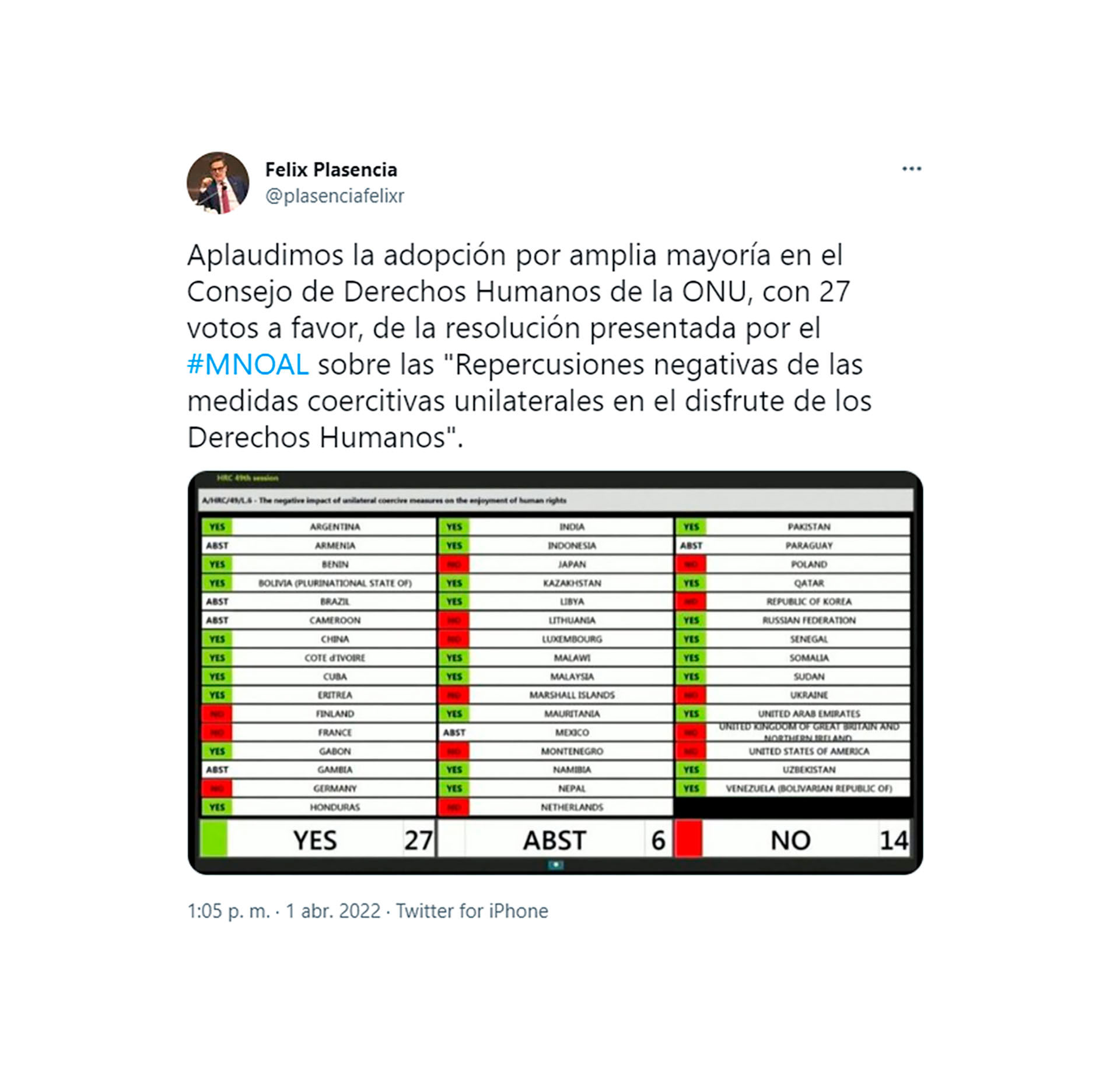
He also insisted that sanctions are a “criminal scourge” and that their imposition goes against the principles of international law and the UN Charter. “We are the undisputed majority. Venezuela continues to strongly reject the criminal scourge of unilateral coercive measures, along with 120 member countries of the Mnoal and other nations of the international community that respect the principles of international law, multilateralism and the UN Charter,” said Plasencia.
The resolution urges all States to cease sanctions that it considers “contrary” to the “norms and principles governing peaceful relations... that create obstacles to trade relations and impede the full realization of the rights set forth in the Universal Declaration of Human Rights”. It also calls upon sanctioners and United Nations agencies to “take concrete measures to mitigate the negative impact of unilateral coercive measures on humanitarian assistance”, and urges countries to promote multilateralism and strengthen cooperation to address the impact of such measures.
The resolution driven by the Chavista regime seeks to discredit international sanctions as a method of suffocating dictatorial regimes.
The decision was supported by sanctioned and friendly countries sanctioned for the brutality of their regimes against the population demanding democracy. In addition to Maduro's dictatorship, Russia — for its ruthless invasion of Ukraine; China for violence against minorities; Nicaragua, for imprisoning all opposition leaders; and Cuba for systematically repressing and imprisoning dissent — are on the blacklist of the US and the European Union.
In fact, in the vote on this resolution, the US, France, Finland, Japan, Norway and Ukraine, among others, strongly voted against it.
Brazil, Mexico and Paraguay were part of the group from which they abstained.
KEEP READING:
Últimas Noticias
Debanhi Escobar: they secured the motel where she was found lifeless in a cistern
Members of the Specialized Prosecutor's Office in Nuevo León secured the Nueva Castilla Motel as part of the investigations into the case

The oldest person in the world died at the age of 119
Kane Tanaka lived in Japan. She was born six months earlier than George Orwell, the same year that the Wright brothers first flew, and Marie Curie became the first woman to win a Nobel Prize

Macabre find in CDMX: they left a body bagged and tied in a taxi
The body was left in the back seats of the car. It was covered with black bags and tied with industrial tape

The eagles of America will face Manchester City in a duel of legends. Here are the details
The top Mexican football champion will play a match with Pep Guardiola's squad in the Lone Star Cup

Why is it good to bring dogs out to know the world when they are puppies
A so-called protection against the spread of diseases threatens the integral development of dogs


