


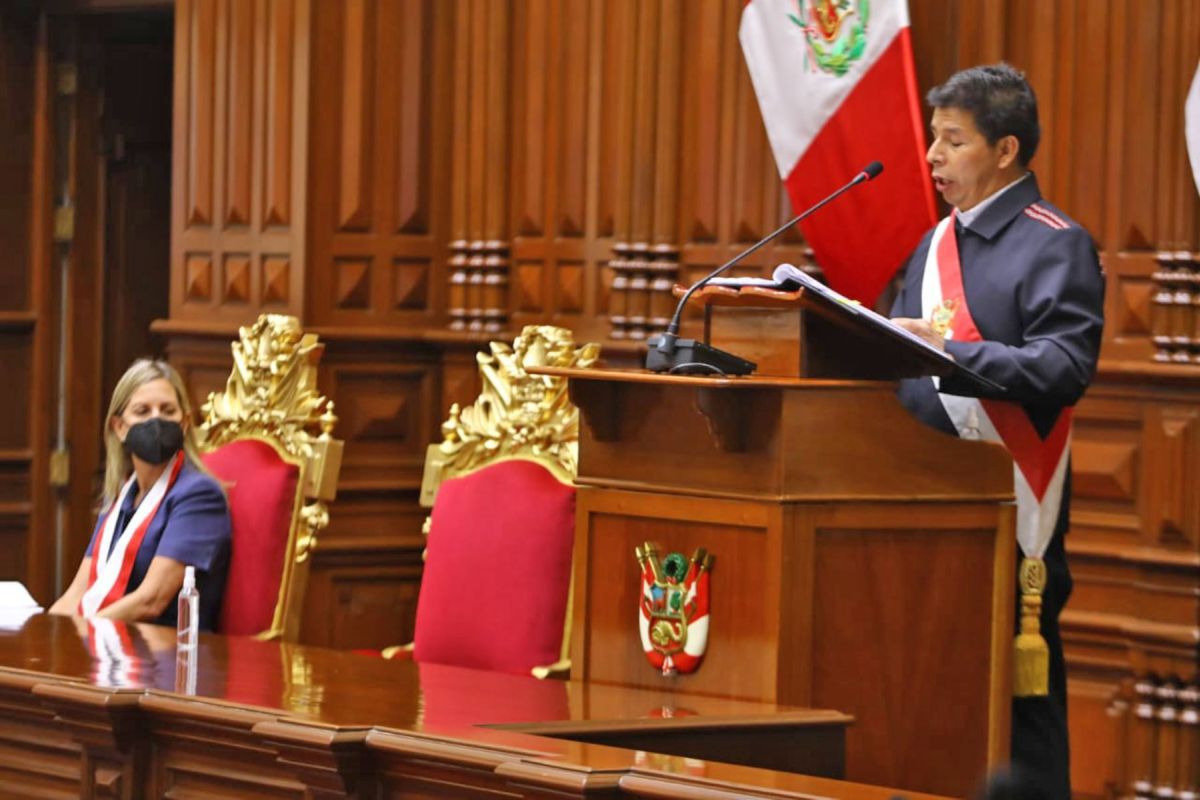
Pedro Castillo will be presented today at the Congress of the Republic where he will defend himself against the accusations made by the opposition in the vacancy motion presidential. The president's presence in Parliament is scheduled for 5:00 p.m. (Peruvian time).
Given this, the congressman of Peru Libre and former prime minister, Guido Bellido, spoke on Twitter and compared the controversy of the missed goal in Peru vs. Uruguay with the current political situation.
“Last Thursday a referee stole the match from us, I hope that this Monday the Fujimoristas will not rob us of the government legitimately won at the polls by the people,” he said on the social network, where some followers and opponents of Pedro Castillo asked him not to mess with the Peruvian national team and that the best thing is that “they all go.”
Since the vacancy motion was approved and with it the presence of Castillo Terrones in the Plenary Congress, the clashes between government supporters and the opposition have not stopped. Even the president himself has launched diatribes against those who are behind the presidential vacancy.
From Cajamarca he responded to the criticism and said that “I'm not going to suck myself, I'm not going to run before a tiny group that wants to ignore the will of the people, for me there is not a step back. I am where the people have put me.”
But today, in a more leisurely and conciliatory tone, he stressed that “I am thinking about the country. We have been chosen to meet the great demands. We have been democratically elected. The popular will is expressed at the polls and we are not going to let it down. Let's hope that today this page will close and continue to work together,” said the head of state
ATTEND THE CONGRESS
The Peruvian Congress today debates the motion to impeach leftist president Pedro Castillo for alleged corruption and lack of direction, a figure that has already led to the fall of two leaders since 2018.
The plenary session of the Peruvian parliament is scheduled for 3:00 p.m. (Peruvian time), “in order to debate and vote on the vacancy request of the Presidency of the Republic,” as convened by the head of Congress, conservative María del Carmen Alva.
The outcome is anyone's guess because the opposition lacks the 87 votes required by the Constitution to remove a president. Of the 130 legislators, the opponents number about 80, while the rulers of the Marxist Peru Libre and related groups are around 50.
“To be honest, there are no votes yet. There are approximately 76 votes,” said Sunday's Norma Yarrow, of the right-wing Avanza País, one of the parties that is driving the impeachment.
If Castillo is removed, he will be replaced by his vice-president Dina Boluarte, although if she withdraws, it will be up to the head of Congress to take office.
The session will begin with a speech by Castillo, who has up to an hour to respond to questions against him. Then his lawyer will follow the details of the debate, with the right of reply. The president does not participate in this stage.
This is the second vacancy motion against Castillo, who assumed the presidency in July 2021 after winning a tight ballot against right-wing Keiko Fujimori. In December, Congress dismissed a similar measure.
However, a dismissal has been in the air since his election in 2021, when his rivals denounced “fraud” despite the endorsement of their victory by the OAS, the European Union and the United States.
THE REASONS FOR VACATING A CASTILLO
Congress decided two weeks ago to take Castillo to a lightning impeachment trial by 76 votes, 41 against and one abstention.
The opposition accuses Pedro Castillo, a 52-year-old rural teacher, of lack of direction and allowing alleged corruption in his environment. He is also criticized for his constant ministerial crises that translate into four cabinets, something unprecedented in Peru.
To realize their wish, the opponents appeal to a controversial and flexible constitutional article, which allows the president to be removed from office based on political rather than legal evaluation.
“Declare the permanent moral incapacity of the President of the Republic, citizen José Pedro Castillo Terrones, as established in article 113, paragraph 2, of the Political Constitution of Peru,” says the text of the motion to dismiss.
Coinciding with the impeachment of the president, a survey by the Institute of Peruvian Studies released this Monday by the newspaper La República revealed that 79% of Peruvians fail the performance of Congress, above Castillo's disapproval (66%, according to the latest Ipsos poll, three points less than in February).
Since 2017, six vacancy motions have passed through the Peruvian Congress. Similar requests led to the fall of Pedro Pablo Kuczynski (right), in 2018, and Martín Vizcarra (center), in 2020.
One of the reasons why this mechanism became recurrent is the absence of a parliamentary majority of the government in office. This has been happening since 2016, when Peru entered a clash of powers dynamic that led it to have up to three presidents in one week in November 2020.
The Inter-American Commission on Human Rights of the Organization of American States has expressed its concern, noting that “the presidential vacancy due to permanent moral incapacity has no objective definition, nor has it been interpreted by the Constitutional Court of Peru, which may affect the separation of the country and independence of public authorities”.
The Community of Latin American and Caribbean States (CELAC) expressed solidarity with Castillo Terrones and urged respect for the “popular will” in a March 14 statement.
Despite political tension, Peru is calm and all public and private activities are proceeding normally.
KEEP READING
Últimas Noticias
Debanhi Escobar: they secured the motel where she was found lifeless in a cistern
Members of the Specialized Prosecutor's Office in Nuevo León secured the Nueva Castilla Motel as part of the investigations into the case

The oldest person in the world died at the age of 119
Kane Tanaka lived in Japan. She was born six months earlier than George Orwell, the same year that the Wright brothers first flew, and Marie Curie became the first woman to win a Nobel Prize

Macabre find in CDMX: they left a body bagged and tied in a taxi
The body was left in the back seats of the car. It was covered with black bags and tied with industrial tape

The eagles of America will face Manchester City in a duel of legends. Here are the details
The top Mexican football champion will play a match with Pep Guardiola's squad in the Lone Star Cup

Why is it good to bring dogs out to know the world when they are puppies
A so-called protection against the spread of diseases threatens the integral development of dogs


