


Social networks have become the ideal space for the proliferation of riddles and riddles. In this context, users begin to share different challenges for the most restless minds.
Such is the case of this new puzzle that invites you to find three pairs of glasses hidden in the middle of a sea of scissors. Next, the image mentioned. The challenge is to find the glasses in about 10 to 15 seconds.
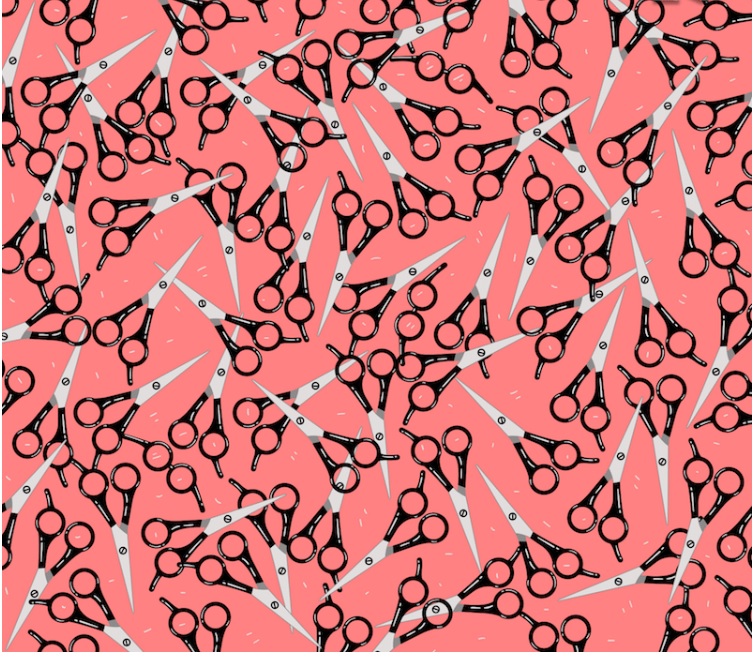
In case it has not been resolved in such a short time, you can rest your eyes for a few seconds and try again. Sometimes it helps to put your eyes somewhere else for a while and then look at the image of the challenge again.
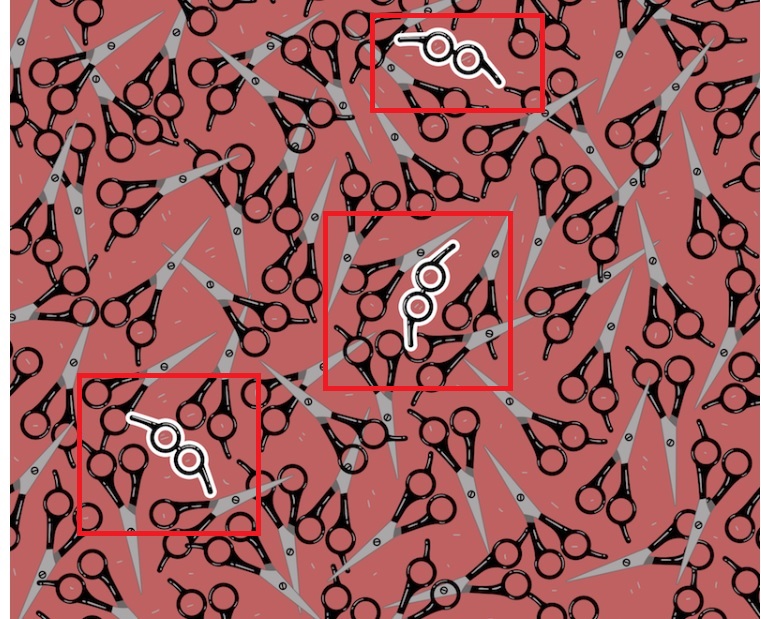
Next, the solution of this riddle. The glasses were highlighted so that the location can be seen well:
The shapes, colors and the arrangement of different objects on a canvas contribute to generating optical illusions that constitute real challenges. The brain tries to organize a series of stimuli that, due to different situations, can cause confusion.
Images where it is difficult to visualize shapes, to find hidden objects even in which some see one object or another. These kinds of challenges have existed for a long time and networks only helped to make them viral or increasingly visible.
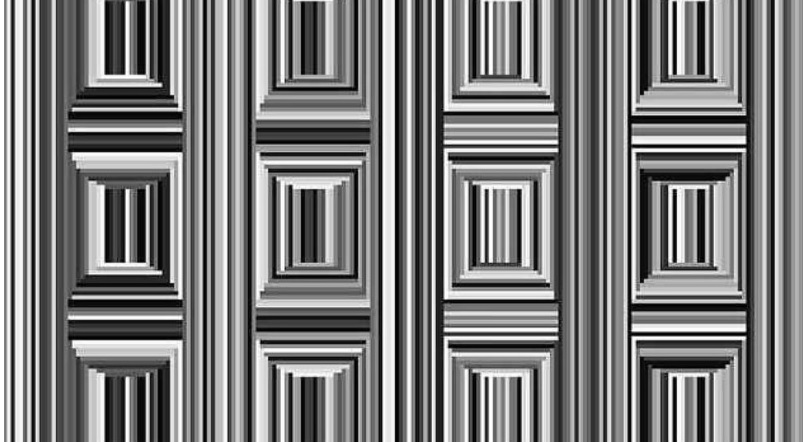
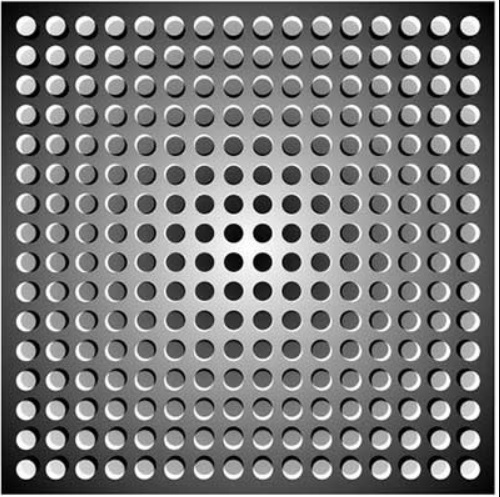
Among the many puzzles of this type, there is the one that invites you to find circles in an image where there only seem to be straight lines, as shown below.
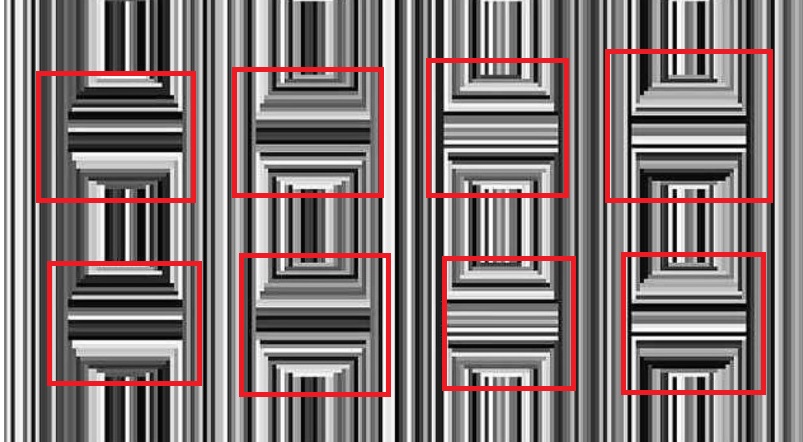
The truth is that in this photo, where there seem to be only rectangular figures, there are circles that are difficult to perceive simply because right angles and shadows stand out more on straight lines than in those that are circular. The trick to seeing the circles is to set your gaze in the center.
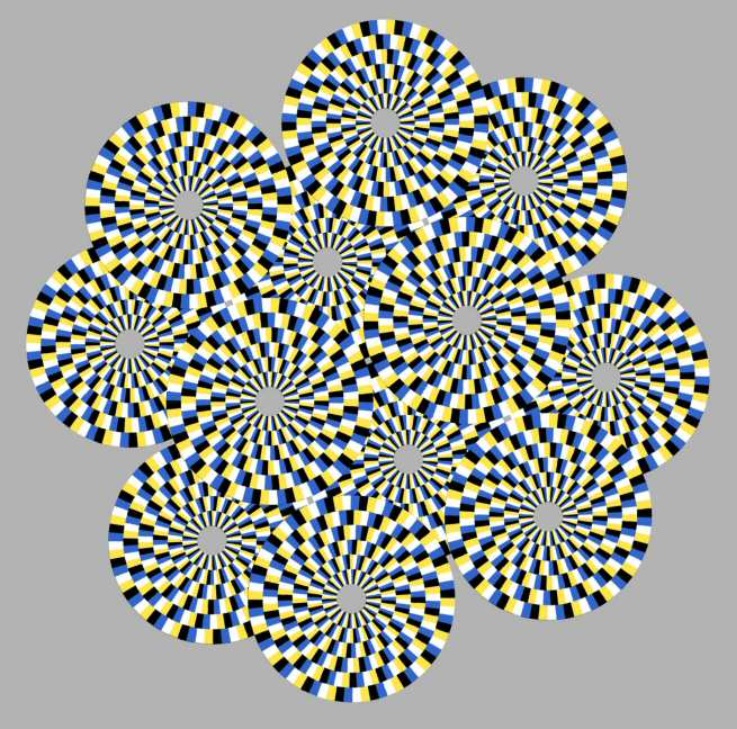
Sometimes the arrangement of geometric figures generates an illusion of movement that doesn't really exist. This can be seen in different graphs such as the one shown below.
When several shapes appear in the same image, the brain has difficulty processing all that information and illusions such as those of movement appear.
The different shades as well as the shadows can give the impression that there are moving figures when in reality that does not happen.
In 2020, researchers at Damon Clark, from Yale University in the United States, identified that the way in which the human brain is deceived by optical illusions is similar to how such deception occurs in flies.
The specialists evaluated specific types of neurons involved in the detection of movement in flies and found a pattern of responses created by the static image. By activating and deactivating these same neurons, the researchers were able to modify the perception of flies of this so-called movement, which is a mere optical illusion.
By turning off two types of motion detection neurons, they eliminated the optical illusion completely. By turning off only one of the two types, flies recorded the supposed movement in the opposite direction to that when both classes of neurons were active.
With this information, they concluded that optical illusion occurs as a result of small imbalances. They then sought to replicate this same experience with humans and were able to prove that the underlying mechanism in the perception of optical illusion in humans works in a similar way to that of flies. While the human visual system is much more complex than that of these insects, the way in which optical illusions occur is broadly based on the same principle.
KEEP READING:
Últimas Noticias
Debanhi Escobar: they secured the motel where she was found lifeless in a cistern
Members of the Specialized Prosecutor's Office in Nuevo León secured the Nueva Castilla Motel as part of the investigations into the case

The oldest person in the world died at the age of 119
Kane Tanaka lived in Japan. She was born six months earlier than George Orwell, the same year that the Wright brothers first flew, and Marie Curie became the first woman to win a Nobel Prize

Macabre find in CDMX: they left a body bagged and tied in a taxi
The body was left in the back seats of the car. It was covered with black bags and tied with industrial tape

The eagles of America will face Manchester City in a duel of legends. Here are the details
The top Mexican football champion will play a match with Pep Guardiola's squad in the Lone Star Cup

Why is it good to bring dogs out to know the world when they are puppies
A so-called protection against the spread of diseases threatens the integral development of dogs


