


Josefina Sosa reads a slogan in her notebook. He is six years old and is studying first grade at the rural school 1-140 Maestro Luis Ponce, in General Alvear, Mendoza. Like almost all children in Argentina, in 2020 their contact with the garden — to make room 4 — was virtual. During the first half of 2021 his group attended room 5 intermittently, separated into bubbles. Only in the second half was the presence full.
Josefina had a hard time adapting. “She didn't want to get rid of me, or to be left in the garden. In addition, she had peritonitis, so she didn't attend for a few days, although she was with a hospital teacher,” says Silvana Suárez, her mother.
PUBLICIDAD
Despite all these setbacks, a month after starting her first grade, she can write and read according to what is expected at her age. That is, she considers herself a literate student. And she's not the only one in this situation.
Of the group of 21 boys and girls — many in situations of vulnerability — in Josefina's room of 5, eight were able to read and write and had good reading comprehension at the end of the Initial Level. The others, some because they were younger, although they did not achieve that level of literacy, ended up very advanced and with an important reading comprehension. “Before the pandemic, out of a group of 20, only two students finished literate,” says Mariela Vera, Josefina's gardener teacher last year.
PUBLICIDAD
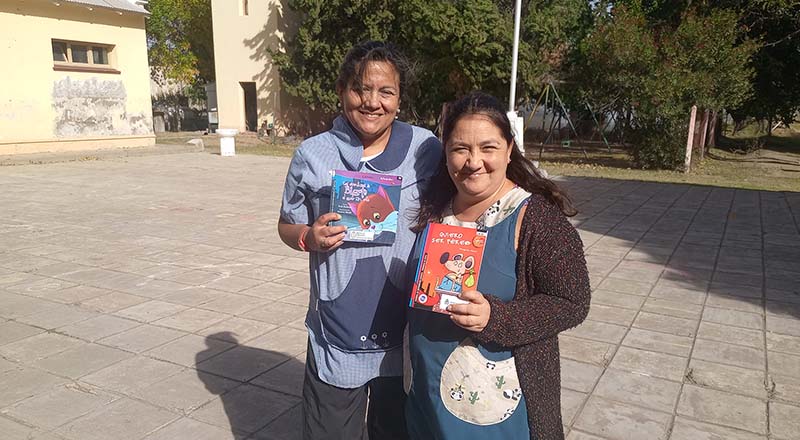
How was this achieved? Everything indicates that the difference was in the articulated work done last year by Mariela Vera and Mercedes Sánchez, the first grade teacher of the primary school that operates in the same building. And in the reading of two children's novels.
PUBLICIDAD
“I have 20 years of teaching and last year was the hardest year of my life,” Vera says. He explains: “These were months of constant adaptation; we started with bubbles, then infections increased and many families stopped sending their children, so I had to divide my time with the group between remote work, which some demanded, and face-to-face work.”
Only in August did classes begin with full face-to-face. By then, some boys and girls had only gone to school for 11 days. “The usual heterogeneity deepened and the level of tiredness from the constant effort of adaptation was difficult to cope with. But what we ended up achieving gave me the guideline that the quality of learning is not directly related to the number of school days but, in our case, to working on literacy in an articulated way with the first grade, focusing on reading and writing. Awakening children's desire to read”, says the teacher.
PUBLICIDAD
Most of the families of the students of the Maestro Luis Ponce school are linked to agricultural work in the region, which is unstable and highly informal. That's why they live on changas for many months.
“From the economic point of view, they are families in a situation of vulnerability. In terms of training, fathers and mothers have at most the complete primary. But they are families who see education as a possibility of evolution and improvement for their children. They are families that respect the teacher and the school, they value our word”, says Vera.
PUBLICIDAD
In most homes there are no books, only some magazines or brochures that churches hand out. “The boys didn't know folk tales like Little Red Riding Hood or The Cat in Boots. We see that the habit of telling stories in families is lost. That's why we proposed that parents tell their children what they did during the day,” says the teacher.
Read novels
PUBLICIDAD
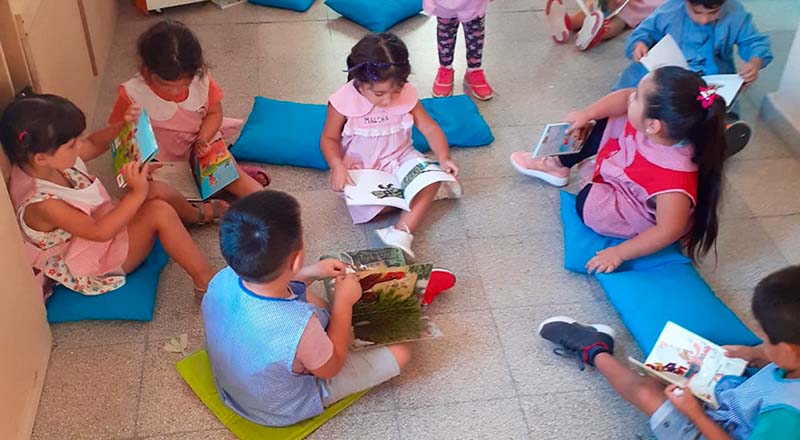
Although Josefina's group had studied room 4 during 2020 remotely, with printed materials delivered by the teacher and contacted her by WhatsApp, she arrived in room 5 with some habits incorporated by the families, which facilitated the task in the room.
PUBLICIDAD
“They were boys who listened, respected each other, were ordained. That basis allowed me to make rapid progress in learning and overcome the deficiencies they brought: little vocabulary (which did not allow them to express what they needed or was happening to them), difficulties in pronouncing some words and organizing sentences when they were speaking,” says Vera.
The teacher explains that the objective of room 5 is to learn to distinguish the different phonemes (sound of letters) in a word. Thus, once the boys and girls manage to relate the letters and their sounds, they can begin to build words, write and read. Normally, this process begins to develop in Initial and is established in the first grade.
PUBLICIDAD
During the first part of last year, Vera's group read stories. But as early as August, the teachers decided to articulate their work, gather their 5th and first-grade students, and read them two novels together. First: The Adventures of Mustache, the Tailless Cat, by Ruth Kaufman. After: I want to be Pérez, by Margarita Mainé.
“That motivated the kids in the garden a lot and allowed them to meet their teacher this year. And the first graders, who had not had a classroom of 5 in person, allowed them to have a moment of enjoyment, of returning to the garden and having the teacher read to them,” says Vera.
Sánchez, meanwhile, dedicated himself to making audiovisual contributions. I searched and projected images, audios, videos to recap what was read the day before and show the meaning of some words. For example, his students investigated what a museum was (because part of one of the novels takes place there), the different types of museums that exist and visited the natural science museum near the school.
They also found out what a choir was, Sanchez showed them videos, formed a choir with their music teacher and sang at the end of the year for their families (who instead of throwing tomatoes at them, as was the case in the novel, they threw candy at them).
Learn to learn
First, the teachers encouraged their students by telling them that they read novels because they were bigger. Then, they explained to them what a novel is and how a book is formed — cover, back cover, title, author, chapters, etc. And they decided together that they would read one chapter a day.
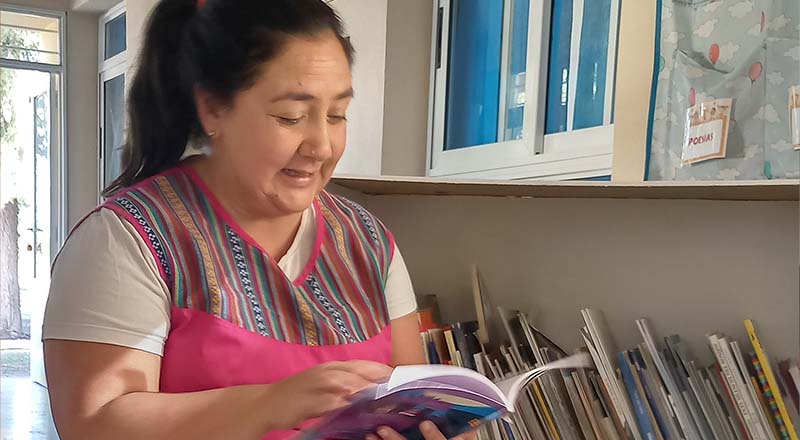
“The interesting thing about reading novels is that it develops a lot of reading comprehension in children. Because they have to follow the thread of the story and for that every day we recapitulated collectively: who the character was, what was wrong with him, where he lived. And we were trying to anticipate what could happen from the title of the chapter. 'What do you think is going to happen? ' , was the triggering question”, specifies Vera.
With the other novel, that of Perez, the boys and girls worked what means that their teeth fall out, wrote letters to the Perez mouse and created a goose game on the subject, with which they could exercise addition and subtraction.
In Josefina's room, some families had very poor literacy. Vera took this trait into account when writing slogans for children to develop in their homes. For example, “when we read the novels, if I had to share with them the chapter we had discussed in the room, I would send them to them in audio (read by me) and in text, so that they could listen and read together. And complete slogans such as: 'Mark the words I don't know the meaning of, '” he says.
The joint work allowed boys and girls to “develop skills rather than skills,” adds Sánchez. And he exemplifies: “To learn from error, that if I feel bad I ask for help, to solve problems, to learn to learn, which is not only learned in school but also in the library, in an exit. The idea is that when faced with a problem, they know where to look and who to ask.”
First-graders delved into digital literacy, editing texts in Word, the new vocabulary that came from novels and began to see the possibilities of programming their own video games through Scratch.
“The children were also able to do typical garden activities that they had not been able to do due to the pandemic and the lack of attendance, which hindered the learning process. For example, cutting out or working with plasticine,” says the first teacher.
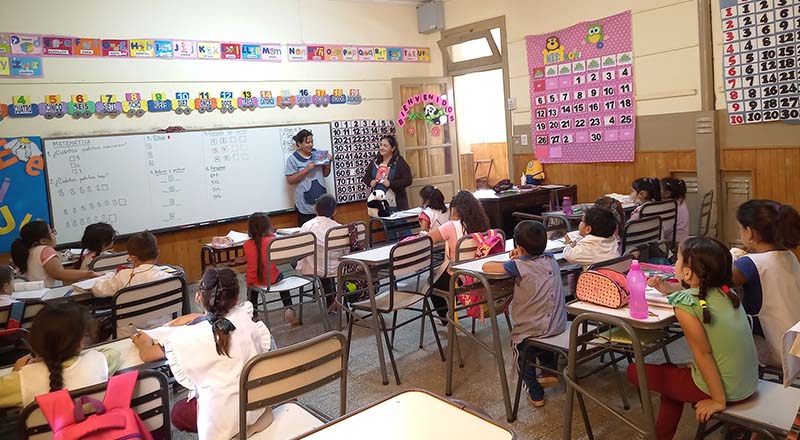
Regarding the literacy process of those who did first grade in 2021, Sánchez adds, “there were 12 children, who are the ones who attended most regularly, who ended up fully literate, achieved the knowledge and skills of the first grade. Two failed to become literate and three achieved 75% of the objectives proposed for this stage.”
While in the first grade of 2022, the teacher says, “there are no longer as many difficulties as last year, the development of habits, emotions, work with the other is very noticeable”. In addition, “Mariela worked a lot with families over the past year. So, today if the child did not finish the activity, I send the photo to the parents and complete it at home. In 95%, the tasks I command are done again.”
Both teachers say that last year they worked hard on the importance of face-to-face, stressing that certain learning needs other times, different from those of television and video games.
While reading one of the novels, the children were isolated for a week by those infected with COVID-19, “Josefina was anxiously waiting for the chapter that she sent them on WhatsApp, at 14 or 14.30 hours, played by her,” Silvana recalls.
Josefina's mother has two older children, aged 16 and 12. “From the experience I had with my other children who did the whole garden in person, what Josefina achieved without having had face-to-face classes in room 4 and with only half a year of face-to-face continuity in room 5 is amazing.”
___
This note is part of the Solutions for Latin America platform, an alliance between INFOBAE and RED/ACTION.
PUBLICIDAD
PUBLICIDAD
Últimas Noticias
Debanhi Escobar: they secured the motel where she was found lifeless in a cistern
Members of the Specialized Prosecutor's Office in Nuevo León secured the Nueva Castilla Motel as part of the investigations into the case

The oldest person in the world died at the age of 119
Kane Tanaka lived in Japan. She was born six months earlier than George Orwell, the same year that the Wright brothers first flew, and Marie Curie became the first woman to win a Nobel Prize

Macabre find in CDMX: they left a body bagged and tied in a taxi
The body was left in the back seats of the car. It was covered with black bags and tied with industrial tape

The eagles of America will face Manchester City in a duel of legends. Here are the details
The top Mexican football champion will play a match with Pep Guardiola's squad in the Lone Star Cup

Why is it good to bring dogs out to know the world when they are puppies
A so-called protection against the spread of diseases threatens the integral development of dogs


