


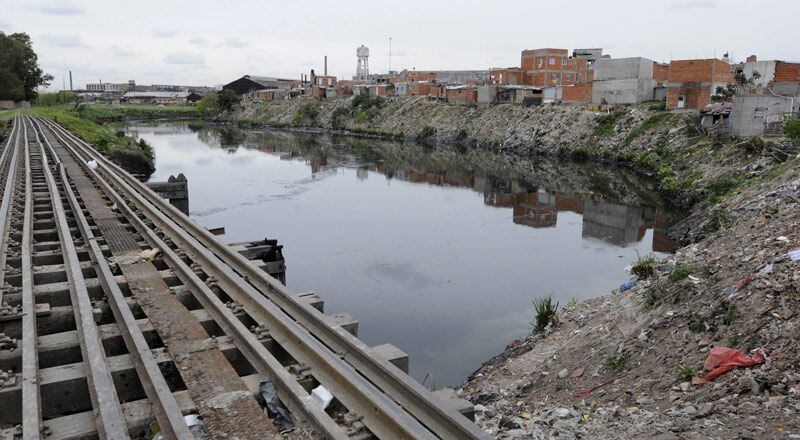
62% of the students of the Nuestra Señora del Buen Consejo Institute live in village 21-24 and the rest in neighborhoods close to the school such as La Boca, Constitución, Lugano or in the southern part of the province of Buenos Aires. From school, they detected that one in ten secondary school students did not have hot water in their home and bathed by heating water in a jar, with carafe gas or with an electric resistance, which could cause electricity cuts in the neighborhood, danger of electrocution or the beginning of fire.
Faced with this problem, the teaching team set out to carry out an impact project for the community with the 47 fourth-year students. Fabiana Fraga was the leading teacher of the initiative. He presented the girls with a list of topics to work on over the past year and they chose solar energy. “From there, we did the survey in which we found that 10% of the students did not have hot water in the house and we continued to investigate to see how we could bring a solution,” she explains.
In May 2021, the project was defined and, from then on, the students carried out research through which they learned about the Sumando Energías Foundation, which builds solar collectors by reusing materials. The girls were interested in the initiative and decided to replicate it to respond to the specific problem of their community.
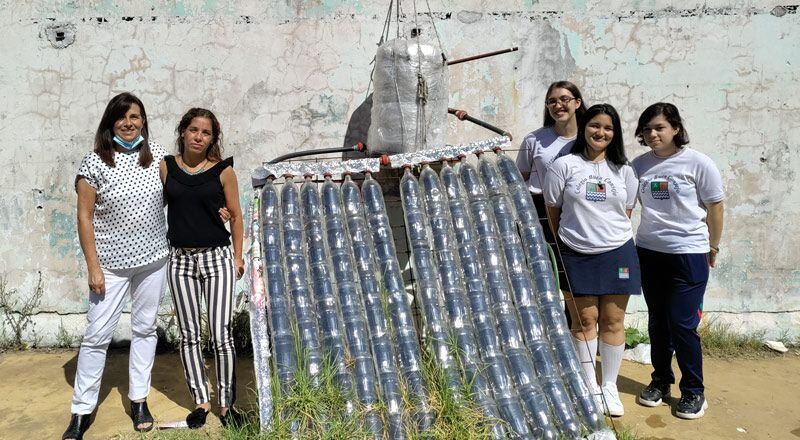
The intention was to show families that it was possible to obtain hot water in a sustainable way. The peculiarity of the collector that the students wanted to make was that it was built with recyclable materials such as PET plastic bottles, aluminum cans and tetra brik containers. The collection of material involved the garden, primary and secondary school.
“The idea was to implement more innovative practices in the classroom. Different teachers were involved and each one from their area complemented the project,” says Alejandra Fernández Pedemonte, director of this school.
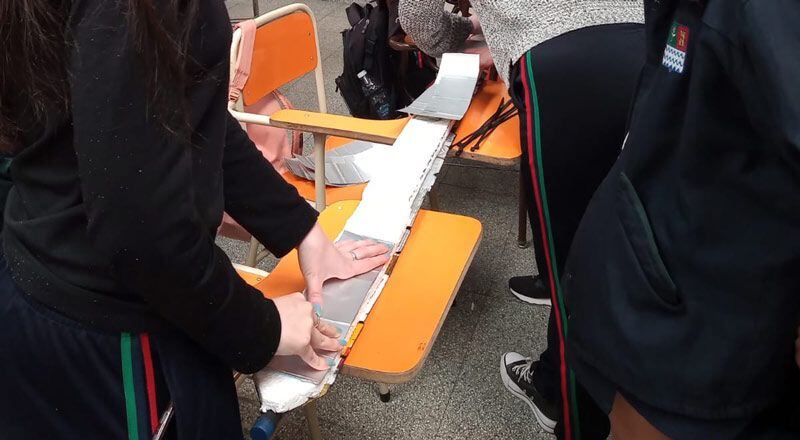
The material collection campaign was organized by the students themselves. Waste that ended up in informal burning or in a landfill became raw material for a sustainable and environmentally friendly solution for homes where hot water was lacking. This first stage took the longest. Then, the assembly of the collector was quick.
The project also intended to raise awareness and train the community about the use of solar energy as an alternative to gas or electricity. In addition, a meeting was held for families in order to train them in the construction of the collector so that they could do it in their homes if they wished.
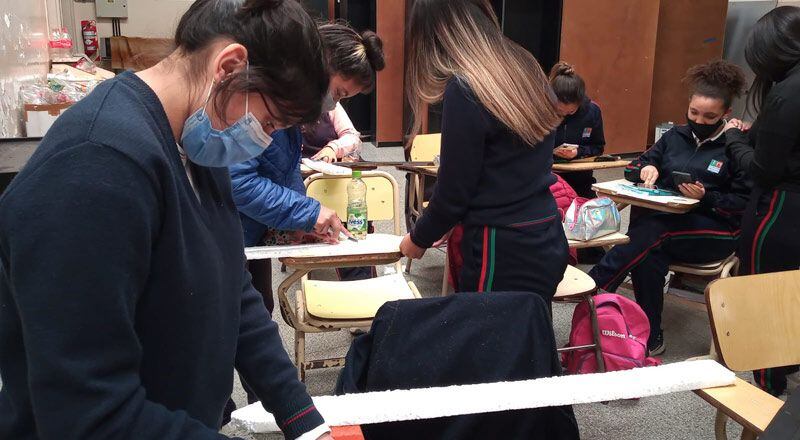
Social and environmental impact
The project, which was called Rays of Dignity, allowed the students to learn about the use of solar energy and develop soft skills such as critical thinking, problem solving, autonomy, social awareness, collaborative work and affective and effective communication. “These practices, in which female students are active protagonists, empower them. These projects give meaning to learning,” says Fernández Pedemonte.
Yamila Peralta, one of the students who participated in the assembly of the solar collector and is now in the fifth year, says that the project was important to encourage teamwork. “We were far apart and it was difficult to work in a group,” he says. He adds, “We also saw how important recycling can be to help other people and the planet.”
Another student, Karina Martínez, says: “The project helped me to see the different situations that each one is experiencing. In the pandemic, many difficult things happened and finding a project that would help solve a problem I really liked. I learned to put myself in each other's shoes.”
Rocío Podkowa is also part of the course that developed the project. She notes: “I was very shocked to see that natural resources are being depleted. That's why we decided to use a renewable resource such as the sun to have hot water.”
How it works
The solar collector is composed of two parts. On the one hand, there is the tank, and on the other, the pipes made of recycled materials. “We used 230 cans, 160 bottles and 60 containers of tetra brik,” Fraga says.
About the operation, Karina explains: “First the tank is loaded until it is filled. Then you close the faucet. Water flows down the tubes, which are made of materials that absorb heat, and then the water heats up and rises. Depending on the day, it may take about four hours to warm up. This system allows a typical family of four people to bathe. It's not water to drink.”
At the end of the project, student Leila Tula detected that there were leftover cans. She wanted to take advantage of that material. “It's really nice to recycle, it leads you to stimulate creativity,” he says. Supported by her teacher, she decided to pursue a personal venture. “With those cans I make collector cars and I'm selling them. Of what I earn, I give my dad a share to help the family economy,” says the young woman.
Micaela Marolla is a teacher at the school, is the benchmark in environmental issues and produces a school magazine with information on all the initiatives linked to them. “The solar collector project was the cover note,” he says. He adds: “More and more teachers are interested in addressing these issues in their classes.”
Last year, the solar collector project was presented in the Petersen Group Foundations Program for Educational Innovation — Reimagining the School and won first place in this distinction. The prize was 2 million pesos that will be used to continue the project and renovate part of the school. The call was attended by 95 secondary schools from five provinces.
The prototype of the solar collector is located in the schoolyard. From there everyone can see that the system works. “This year we would like to accompany between 10 and 15 families so that they can build their own collector. The idea is to do it in partnership with a civil society organization,” says Fernández Pedemonte.
On the results of the project, the school director reflects: “With the assembly of the solar collector, the girls were integrated to solve a problem in society. It is important that the school is open to the needs of the community. We need to train citizens who can be protagonists of change.”
___
This note is part of the Solutions for Latin America platform, an alliance between INFOBAE and RED/ACTION
Últimas Noticias
Debanhi Escobar: they secured the motel where she was found lifeless in a cistern
Members of the Specialized Prosecutor's Office in Nuevo León secured the Nueva Castilla Motel as part of the investigations into the case

The oldest person in the world died at the age of 119
Kane Tanaka lived in Japan. She was born six months earlier than George Orwell, the same year that the Wright brothers first flew, and Marie Curie became the first woman to win a Nobel Prize

Macabre find in CDMX: they left a body bagged and tied in a taxi
The body was left in the back seats of the car. It was covered with black bags and tied with industrial tape

The eagles of America will face Manchester City in a duel of legends. Here are the details
The top Mexican football champion will play a match with Pep Guardiola's squad in the Lone Star Cup

Why is it good to bring dogs out to know the world when they are puppies
A so-called protection against the spread of diseases threatens the integral development of dogs


