


In record time, the national government created and eliminated the Under-Secretariat for Resilience Argentina.
Initially, the new office had been created with the aim of mitigating the “globally catastrophic and subjectively traumatic” impact caused by the COVID-19 pandemic on society, as evidenced by a resolution signed by Chief of Staff Juan Manzur.
The idea was short-lived. Manzur himself abandoned the creation of the undersecretariat and announced that the tasks for which it had been planned will be assumed by the Ministry of Health. It happens that a measure involving a new extension of the State at a time when Congress is debating an adjustment as a result of the agreement with the International Monetary Fund generated a strong controversy that the Government is not willing to accept at this time.
The controversy triggered search engine queries about what resilience is. The Royal Spanish Academy gives two definitions. The first seems to be the most appropriate to describe the frustrated government intention: “The ability of a living being to adapt to a disturbing agent or an adverse state or situation”.
Quick to reflex, the Kirchnerist militancy did not let the subject pass and this morning recalled on social networks and Telegram groups that an area with similar characteristics operates in the City of Buenos Aires. This is the Resilience Department, led by David Groisman, under the General Secretariat and International Relations, led by Fernando Straface.
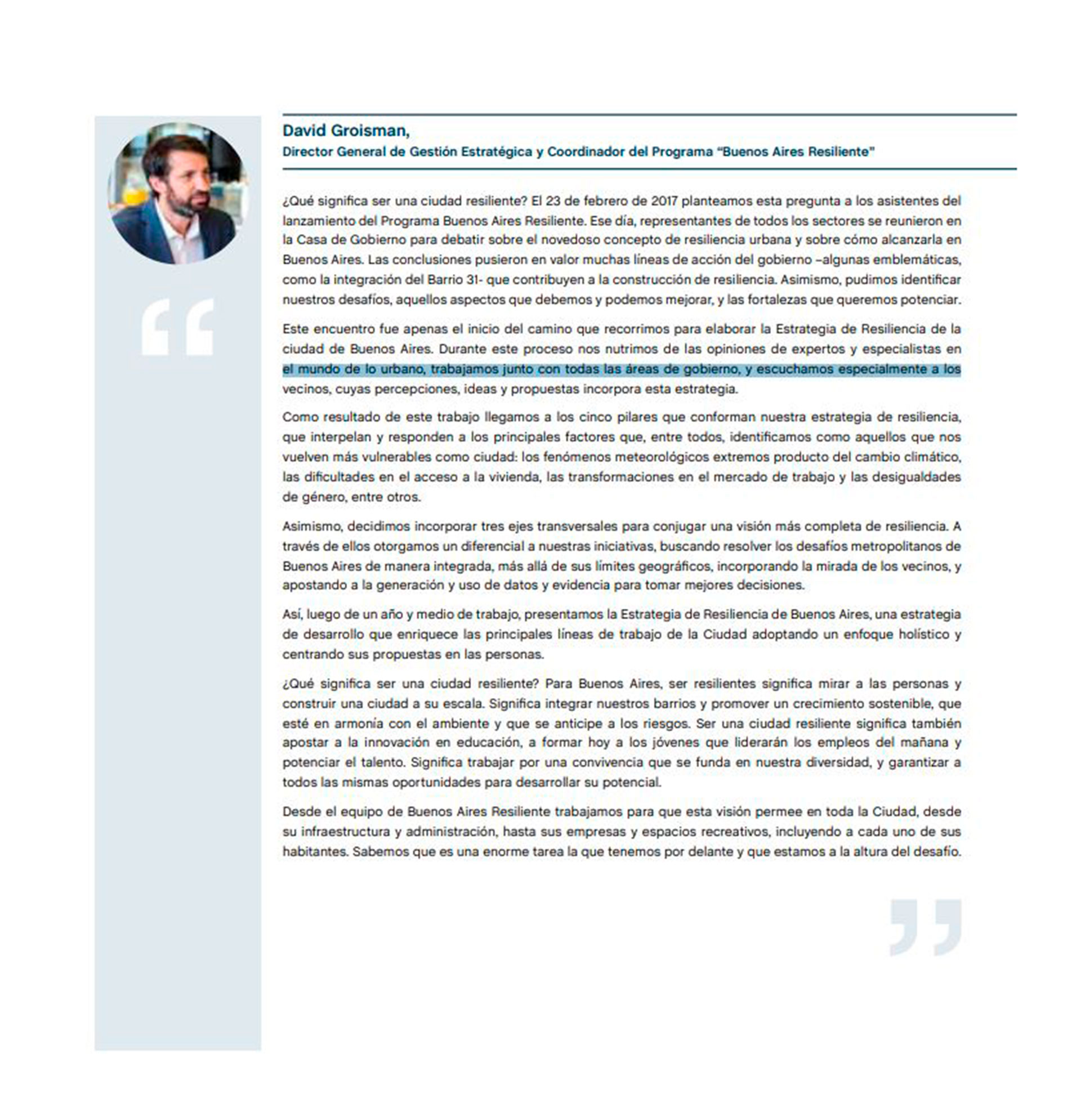
According to the official website of the Buenos Aires government, the office aims to “promote a more integrated, sustainable city that is committed to gender equity and provides opportunities to all its neighbors, focusing among the most vulnerable population”.
It has five axes:
- Diversity, gender and coexistence: Promote the full development of women and diversity as an identity value.
- Innovation, talent and opportunities: Quality inclusive education for the jobs of the future and generation of opportunities for innovation and economic development.
- Environment and sustainability: Promote green infrastructure, sustainable energy and a comprehensive urban waste policy.
- Social and urban integration: Improve access to quality housing, sustainable mobility and promote coexistence and enjoyment of public space.
- Security and Risk Management: Preparing the City for the impacts of climate change, building safer spaces and an informed citizenship to meet these challenges.
According to his LinkedIn profile, Groisman took office in 2015. Before that, he worked at the World Bank and was coordinator of the Government Policy and Management Program of Cippec. In addition, he held a position at the head of the national cabinet between 2006 and 2008, with Alberto Fernández as chief.
KEEP READING:
Últimas Noticias
Debanhi Escobar: they secured the motel where she was found lifeless in a cistern
Members of the Specialized Prosecutor's Office in Nuevo León secured the Nueva Castilla Motel as part of the investigations into the case

The oldest person in the world died at the age of 119
Kane Tanaka lived in Japan. She was born six months earlier than George Orwell, the same year that the Wright brothers first flew, and Marie Curie became the first woman to win a Nobel Prize

Macabre find in CDMX: they left a body bagged and tied in a taxi
The body was left in the back seats of the car. It was covered with black bags and tied with industrial tape

The eagles of America will face Manchester City in a duel of legends. Here are the details
The top Mexican football champion will play a match with Pep Guardiola's squad in the Lone Star Cup

Why is it good to bring dogs out to know the world when they are puppies
A so-called protection against the spread of diseases threatens the integral development of dogs


