


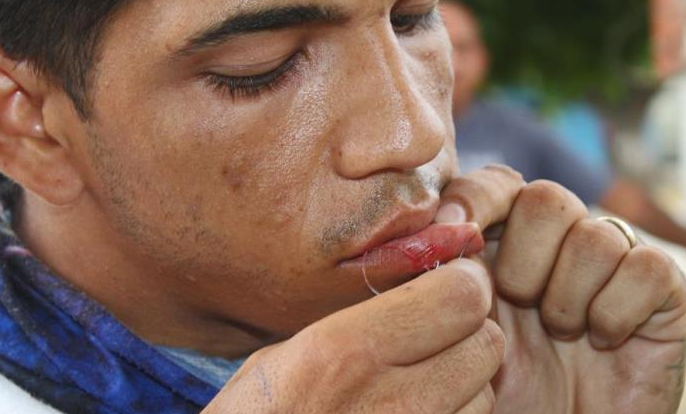
Over the past few weeks, migrants who are (mostly) passing through Mexico, most of them Central American and of Haitian origin, have resorted to a practice in protest against what they consider to be little or no support from the national authorities: lip stitching or hunger strikes. Given this, the Mexican immigration authorities called on them not to self-harm, considering that they became hostages to the interests of third parties.
“The National Institute for Migration (INM) of the Ministry of the Interior calls on migrants not to self-harm or become hostages of third party interests, who claim to defend their human rights, but motivate them to commit actions that damage their physical and psychological integrity,” said the agency on Sunday to through a statement.
The INM also said that it regretted this practice in seeking the attention of the authorities and insisted that Mexican laws and regulations in this area establish routes and instances of care to maintain safe, orderly and regular migration.

As a solution, the institute proposed that migrants go to its offices to regularize their situation, “as others who also left in the same Tapachula caravan have done, including vulnerable groups such as women, minors, older adults or people with disabilities,” they said when deciding on a migration policy that it “respects human rights, addresses their causes and respects the norms established by law”.
The most recent episode of this type of protest by migrants occurred last Friday, when seven members of the caravan called “migrant viacrucis”, tired of being stranded in the Chiapas city of Tapachula for weeks, even months, without their situation being resolved, sewed their lips with needle and thread, while warning that from that moment on, every hour a group of people inside the caravan, second so far this year, would replicate the action.
His intention is to pressure the authorities to give them the documents that allow them to travel freely through Mexico, in order to reach the United States, where they intend to seek asylum.
The Venezuelan Edwin Camacho, one of the aforementioned migrants, warned that they will maintain their protest of suturing their lips until their requests to obtain legal status in the country are echoed and if they fail to do so they will continue with that practice.
“We don't want problems and violence, we just want them to give us the step,” Camacho told Efe.

Meanwhile, compatriot Matías González, a native of Venezuela, asked the Government of Mexico to help them move forward because their goal is not to stay in the country.
“We asked for safe conduct to leave the city, as it has been difficult to follow our path (towards the United States),” he said.
Prior to this action, members of the migrant caravan went on hunger strike when they arrived in the community of Álvaro Obregón, after twice clashing with agents of the National Guard (NG) and immigration personnel in the city of Tapachula.
Federal authorities arrested nearly 200 migrants, including children and pregnant women, segmenting the caravan.
The situation is critical as the authorities of the National Institute of Migration (INM) maintain a checkpoint at the main entrance of the community to prevent them from leaving this village.
Precisely, this Friday, April 1, hundreds of migrants walked out of Tapachula, in order to reach Mexico City to regularize their immigration status, but after a few kilometers they clashed with federal authorities.
This new convoy, called for its proximity to Holy Week as “the Migrant Way of the Cross”, left around 07:00 local time from this city bordering Guatemala, where thousands of migrants have been stranded for weeks and even months.
The contingent, made up of men, women and children, took their bags and set out through the streets of the city to the coastal highway of Chiapas to head towards the capital, more than a thousand kilometers away.
KEEP READING:
Últimas Noticias
Debanhi Escobar: they secured the motel where she was found lifeless in a cistern
Members of the Specialized Prosecutor's Office in Nuevo León secured the Nueva Castilla Motel as part of the investigations into the case

The oldest person in the world died at the age of 119
Kane Tanaka lived in Japan. She was born six months earlier than George Orwell, the same year that the Wright brothers first flew, and Marie Curie became the first woman to win a Nobel Prize

Macabre find in CDMX: they left a body bagged and tied in a taxi
The body was left in the back seats of the car. It was covered with black bags and tied with industrial tape

The eagles of America will face Manchester City in a duel of legends. Here are the details
The top Mexican football champion will play a match with Pep Guardiola's squad in the Lone Star Cup

Why is it good to bring dogs out to know the world when they are puppies
A so-called protection against the spread of diseases threatens the integral development of dogs


