


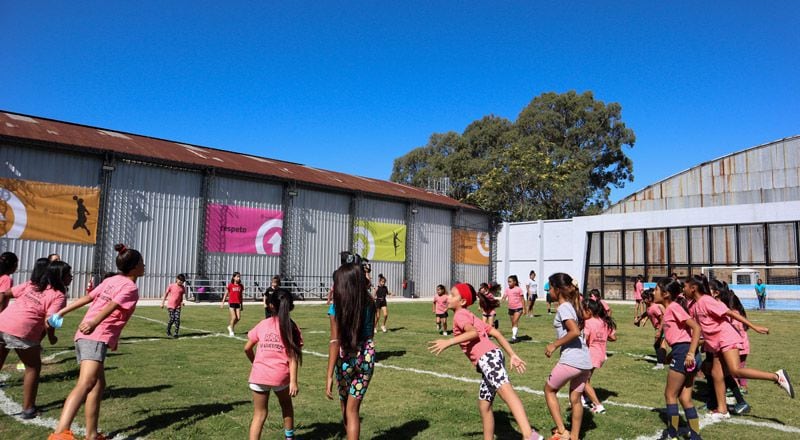
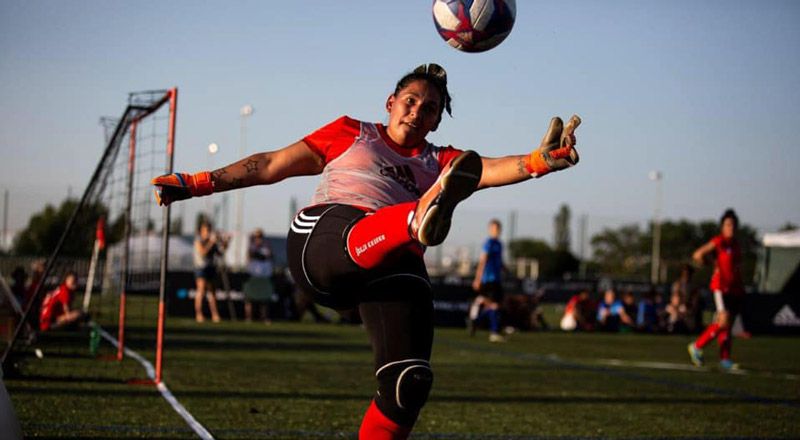
A handful of girls in sportswear manage to put up a sign. The action happens in fast motion. In the background, a cumbia. The sign is the shield. Colourful houses that identify Villa 31 are built on the name of the space: La Nuestra, feminist football. Below, the football. Two presenters — Griselda Domínguez and Alejandra Clavijo — welcome La Nuestra TV's first program, “made by players of all categories”. The images show girls, teenagers and young people on the court, playing games or kicking the ball in the streets of the neighborhood. “For twelve years we have been doing La Nuestra, feminist football. Twelve years of struggle for our place, for our rights, for our part. Today we are almost 100 women who get together every Tuesday and Thursday from 6:00 p.m. to 8:00 p.m. to do what we love most: playing football.”
In 2019, the members of this group decided to start narrating with their own voice. They didn't want to be counted by other people. For a year, many of them, in addition to going to training, were trained to create La Nuestra TV.
The television program is already three years old and La Nuestra turned fifteen. Along the way, she achieved many things in the women's community that she brings together. First of all: that the girls and young people in the neighborhood should have the right to play football. Around this achievement, others were achieved, as a result of this empowerment, ranging from supporting and accompanying vocations to problematizing gender-based violence and the sharing of domestic and care tasks: leaving the house to go and play football with other women can change many things. Also today La Nuestra is preparing to manage a sports center set up by the State, where there will be other sports besides football, for children and adolescents from neighborhoods 31 and Saldías. In ten days, there will be a meeting with international visits—coaches and participants from other women's football venues in Chile, Uruguay and Brazil—to discuss how to run a club in a different way than the one known and where equality and the rights approach are at the heart of management.
“It's a totally different place, it's not just a club,” says Clavijo, 20 years old, Bolivian, a student of Social Communication and a member of the space for 12 years.
She approached when she was 8, at the insistence of her mother who encouraged her to play. At first, I doubted: football, more than a decade ago, “was supposed to be for kids.” When he met La Nuestra, he realized that what was being played on that court was much more than football.
Clavijo grew up together with the group. He acquired sports skills and at the same time professional tools and ways of standing in life.
“I always had character, I always defended myself, but I was a Bolivian girl, villera, who went to a primary school in Recoleta and there were the stigmas that judged, criticized. They bullied me but I always stood up: “Yes, I'm Bolivian, I'm a villain, and that doesn't make me less than anyone else.” Although I have incorporated it since I was very young, playing ball gave me that courage to stand like this. I feel that without La Nuestra my life would be totally different.
Over time, Clavijo learned that in addition to football, he was interested in the media, journalism. Today she is one of the audiovisual producers and photographer of La Nuestra. She is also part of the group that plans and makes decisions, since for the coaching staff the voice of the youngest girls is key.
“Ours gives me the space to continue growing. It is beautiful to have these possibilities that, really, being a villera and a migrant, I don't know if I had. That's what Our Lady has. It's not that I go, I play ball and that's it; there is also a huge pedagogical and accompanying space. There are containment nets that grow and grow. And the girls do not miss an opportunity to let us know that they are there, they are an unconditional support that is felt, inside and outside the neighborhood. It makes me very happy to be part and continue projecting things because in the end this is for everyone: for those who come, for those who are there and for those who once were.
Luciana Martiarena, 21, is another of the young women who have been in La Nuestra for a long time and today they are occupying leadership roles.
“I've been since I was ten. I started playing for my sister, who is a little older; she conveyed to me her passion for football. I watched her play from a very young age, inviting me was the nicest thing she could have done for me.
Like Clavijo, Martiarena was also encouraged by her mother, who had always played football. Also like Clavijo, in La Nuestra, in addition to the ball, he kicked mandates and gambetted prejudices.
—This space opened doors for me, allowed me to ask myself questions. My family is from Jujuy and my parents brought a culture from the north that is still rooted in that women have to know how to do a lot of things around the house and always have to serve men. Being in La Nuestra changed my way of thinking, it gave me the possibility to see that I am not the prejudices, stereotypes or stigmas that society says I am. Today, in addition to playing football, I have a space to problematize, to think, to be able, through containment networks, to build myself as a person and contribute something to society. For me, Our Lady is love, it is sorority, it is passion, it is companionship, it is football.
Winning the court
“The first conquest was that: the pitch,” says Mónica Santino, football player and technical director of La Nuestra, when she recalls how this space began, which is also a social organization and a feminist collective.
Santino doesn't believe in coincidences. Some causality, then, caused him to meet at the 2007 Evita Games with Alison Laser, an American coach who at that time called a group of between 10 and 15 girls to play football in Villa 31.
At that time, Santino had already worked at the Vicente López Women's Center, “in a women's football program designed by UBA Social Work interns in the match's poverty lines. There you could see that the sport that girls chose was football and that from that you could work on a number of things: the body, teenage pregnancies, health... Football was a great excuse to get together.” He had also participated, in 2006, in Villa 21-24, “in a sports project, with Father Pepe, I came in that way”. Laser, who had been in Argentina for a scholarship, was already returning to his country. When he learned what Santino was up to, he offered him: “Don't you want to come to Villa 31 to do something like that?”
“And that's how we started.
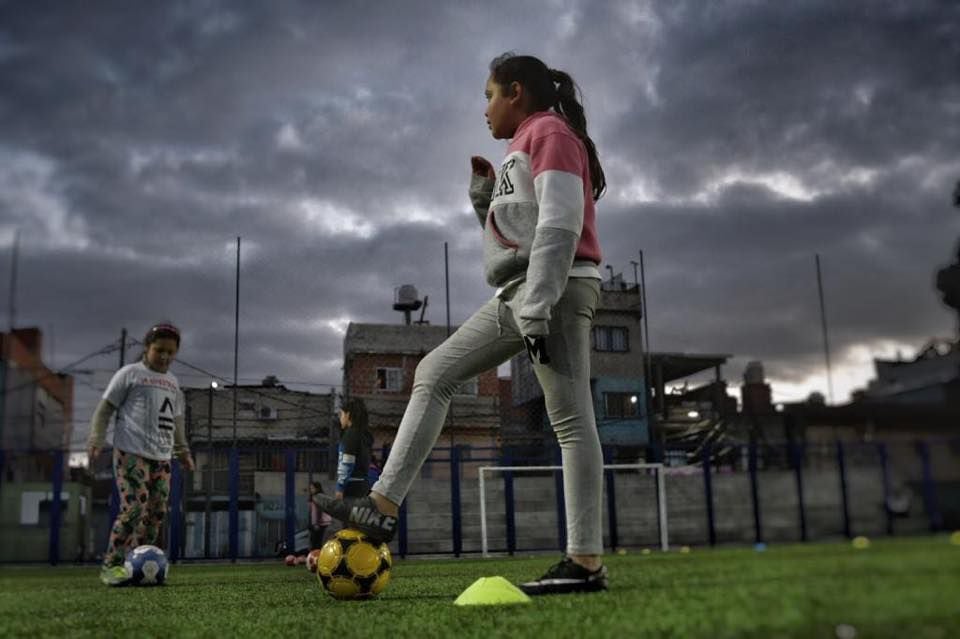
What he found was a court of dirt and stones. The one in the Güemes neighborhood, “which is one of the largest, with a lot of history, where it was notorious that girls had a hard time getting in or that participation was very low. The boys didn't enable the space and we set out to win a training schedule there.” The court was the first fight and the first victory. “With everything that a football field means in a neighborhood, which is the place where everything public happens,” says Santino.
Ours started playing there.
“And it was almost like the cornerstone. That territorial conquest led to more and more teammates joining, it meant growing in number, a lot, and also growing in training level, in ball control. From there we were problematizing what it meant to be a football player in a neighborhood, because we are not just a sports project, we are also highlighting that knowledge acquired in Villa 31.
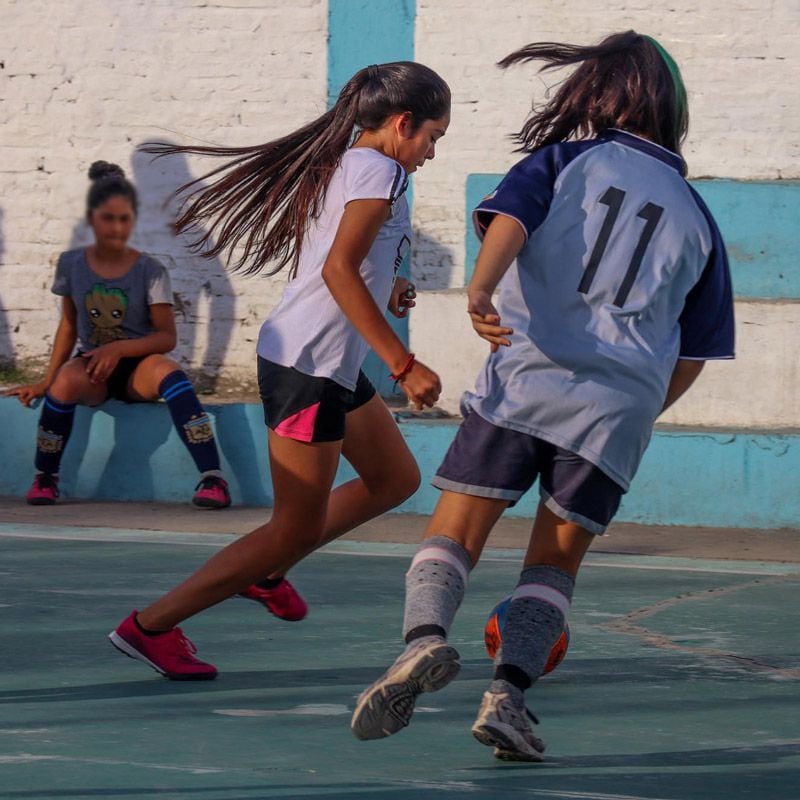
Today, La Nuestra is made up of a squad of 9 female coaches — two of them former players who started at a very young age and trained right there — and technical directors and more than 200 players, aged 5 to 50 and over, who train in different categories, in three different areas of the neighborhood. “The mini ones, which range from 5 to around 10 years old; cadets, up to 14, and the youth and older ones, who all train together with no age limit,” says Enriqueta (“Queta” for those who know her) Tato, who has been a football player, teacher of Physical Education and part of the coaching staff of La Nuestra for almost one decade.
Over time, La Nuestra's court became too small.
In addition to football, she began to organize workshops, talks and trainings on different topics with a common theme: empowering girls and women. From that, from starting to leave the neighborhood, from their participation in the plurinational meetings of women, lesbians and trans, “a very large feminist network around football was woven,” Santino points out, “and somehow, we politically promoted the changes that women's football had. I think we played a very important role in saying and doing, and in getting football on the agenda of the women's movement.”
There are several reasons for those who attend their practices: “There may be some who want to pursue their career as a football player in a club and another where the right to play exercised in a neighborhood means, for example, having arguments to divide the tasks of caring for the male partner and for him to take care of the children while she plays,” says Santino. What impresses its members by participating in this space, beyond what brought them here, is “a body that stands and stands on the court”.
—We say “I stand on the court as in life”, which is a phrase that came out of one of our players. It's putting the ball under the sole, raising your head and saying, “Here I am.” “I can play this sport, it belongs to me too.” And let that base be a great tool to eradicate gender violence, which is what we propose in the deconstruction of a sport that was historically male. Football is wonderful, it makes you realize that you need others to advance and that is the first thing, to get out of the idea of the individual to think that transformations are collective. And for us, as coaches, it is to have a clearer place because in that learning with the girls we find a strategy of collective empowerment that is wonderful, because we had to be better techniques to live up to what the territory required. We are not going to do assistance, we are not going to do charity, we are not going because we are good, we are going to put a right in motion and from that place we stop.
A new step
“Throughout this time, the dream of setting up a club and of institutionalizing all this territorial practice was very strong,” says Santino.
Fifteen years later, they're going to do it.
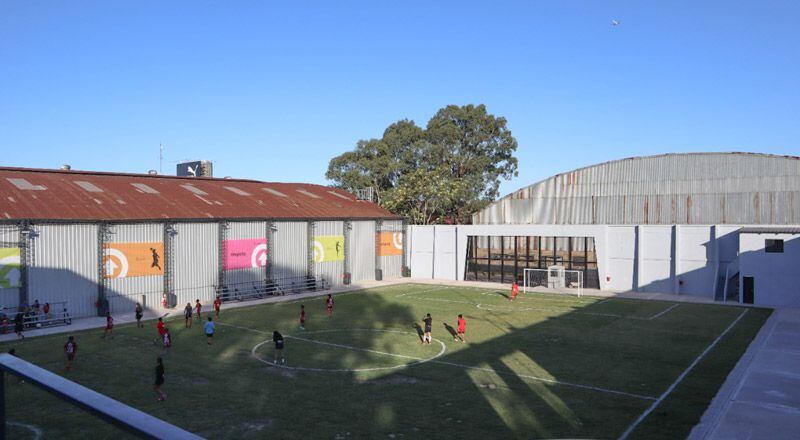
In the midst of a pandemic, when the then Minister of Transport, Mario Meoni (who died in an accident in 2021) was touring Villa 31 in search of a place to test people with symptoms of COVID-19, he came across a semi-destroyed railway shed, on the border with the Saldías neighborhood. The community member Sofía González, who accompanied the tour “raised her hand and said: 'Here is the club that the girls want, 'says Santino. From that moment on, efforts began between the Ministry of Tourism and Sports and La Nuestra to set up a place different from the rest of the clubs, designed by the members of the organization.
—With classrooms, with two courts, with a space where we can expand all this neighborhood knowledge. We wouldn't leave space in the villa. We do think of the place in conjunction with the Saldías neighborhood, which is next to it. We think about filling it with activities that have to do with many compañeras who do aerobics, volleyball, boxing, and who have no roof or place in Villa 31,” says Santino.
The sports center is called Lucía Cullen - Padre Mugica, in tribute to the villero priest and a missing detained social worker who liked sports and was active with him. There, the members of La Nuestra want to develop a wide space where there is room for everyone: for those who plan to train in high competition and for those who want to play for the sake of enjoying the game; for those who are looking to recreate themselves and for those who are going to train and discuss the link between gender and sport; for the youngest who want to play in a club and for the older ones who want a meeting place. A place that will not exclude men, but will be designed and led by those who have “a feminist and rights perspective”. A club that will have women's football as its protagonist but also thinks about basketball, handball, boxing and other activities. A club that is built “from the bottom up and that may, at some point, be able to compete in AFA but with its own space”, explains Santino.
—I'm going to paraphrase it with something very feminist: Virgina Woolf talked about her own room to write and think. The own club has to do with that idea, I would say that it is almost the same as the own room.
The foundation stone or, in the words of Santino, the great kick-off of the space will be a meeting that will take place on April 9 and 10, with national and international guests. In addition to the world of football, La Nuestra invited women from political sectors, trade unions and social organizations. Women are expected from Chile (“who have just professionalized women's football and formed a union”), Uruguay (“who are in the same situation”) and Brazil (“who bring a great contribution to popular education”). In addition, members of the organization Women Win, from the Netherlands, were invited, which usually provides logistical and financial support to women-led sports projects in different parts of the world.
—During the two days there will be panels, workshops and discussion spaces to think about what power is for us and how we build that power in the face of a feminist club. Let that be a manifesto, a basis of what that club is going to be from then on. We imagine it with women's activities to the top, which is what doesn't happen in clubs as we know them. Doing it on the spot seems very important to us because when the ball starts rolling and the club opens the doors, we want something from all this that we dream to happen.
___
This note is part of the Solutions for Latin America platform, an alliance between INFOBAE and RED/ACTION
Últimas Noticias
Debanhi Escobar: they secured the motel where she was found lifeless in a cistern
Members of the Specialized Prosecutor's Office in Nuevo León secured the Nueva Castilla Motel as part of the investigations into the case

The oldest person in the world died at the age of 119
Kane Tanaka lived in Japan. She was born six months earlier than George Orwell, the same year that the Wright brothers first flew, and Marie Curie became the first woman to win a Nobel Prize

Macabre find in CDMX: they left a body bagged and tied in a taxi
The body was left in the back seats of the car. It was covered with black bags and tied with industrial tape

The eagles of America will face Manchester City in a duel of legends. Here are the details
The top Mexican football champion will play a match with Pep Guardiola's squad in the Lone Star Cup

Why is it good to bring dogs out to know the world when they are puppies
A so-called protection against the spread of diseases threatens the integral development of dogs


