


Thanks to the historic cocking of NASA's Perseverance on Mars, scientists have been able to gather more information, finding from the microphones integrated into the rover, that the speed of sound there is different, which could cause problems for humans that might arrive in the future, as the voice would be heard different.
And the goal is that in some years humanity will reach Mars and even be able to colonize it. In that sense, it is that all the possibilities that there are for it to be a reality are analyzed. In this case, sound was analyzed, which is extremely important for communication.
According to measurements presented at the 53rd Conference on Lunar and Planetary Science of the Los Alamos National Laboratory, there is not only a speed of sound on Mars, similar to that of Earth, since it can vary due to the temperature and density of the medium. In other words, the measurement is based on the Jezero crater where the rover cocked and could vary if it moves to another area.
In addition, the red planet has some peculiarities in its atmosphere that affect the speed of sound. As a result, it was found that the speed is 240 meters per second; we must not forget that the measurement could change under other conditions.
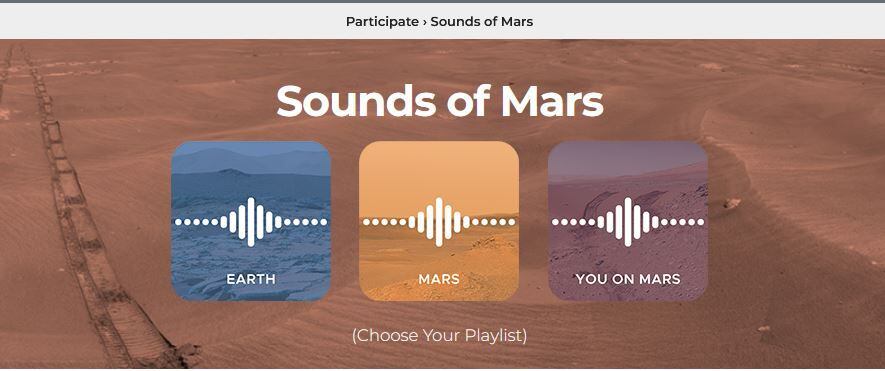
To get a clearer idea of what sound is like on Mars, you can visit this NASA website (https://mars.nasa.gov/mars-sounds/) that allows you to hear some familiar sounds from Earth, and how scientists think we would hear them if we were on Mars. It includes, for example, the greeting of a child, the singing of birds, the beep of a receding truck, the bell of a bicycle and music as they sound on our planet and as scientists anticipate they would sound on Mars. The differences are subtle.
Perseverance's on-board microphone, located on the SuperCam instrument on top of the rover's neck, is used for science and for recording Perseverance audio and natural sounds on Mars.
It captures the sounds of the rover's laser that turns rock into plasma when it hits a target to gather information about the rock's properties, including hardness. Since the SuperCam microphone is located on the rover's remote sensing mast, it can point in the direction of a possible sound source.
“All the science we can obtain with an instrument as simple as a microphone on Mars is impressive,” said Baptiste Chide, a postdoctoral researcher in planetary science at NASA's Jet Propulsion Laboratory and collaborator of the SuperCam microphone in 2021 in a statement.
It can capture, for example, the sounds of pyrotechnic devices fired to release the parachute, the Martian winds, the wheels crackling on the Martian surface, and the roaring engines of the vehicle that descends while flying safely away from the rover. This microphone is ready for further use.
A key objective of Perseverance's mission on Mars is astrobiology, including the search for signs of ancient microbial life. The rover will characterize the planet's geology and past climate, pave the way for human exploration of the Red Planet, and will be the first mission to collect and store Martian rocks and regolites (broken rocks and dust).
(With information from EP)
KEEP READING
Últimas Noticias
Debanhi Escobar: they secured the motel where she was found lifeless in a cistern
Members of the Specialized Prosecutor's Office in Nuevo León secured the Nueva Castilla Motel as part of the investigations into the case

The oldest person in the world died at the age of 119
Kane Tanaka lived in Japan. She was born six months earlier than George Orwell, the same year that the Wright brothers first flew, and Marie Curie became the first woman to win a Nobel Prize

Macabre find in CDMX: they left a body bagged and tied in a taxi
The body was left in the back seats of the car. It was covered with black bags and tied with industrial tape

The eagles of America will face Manchester City in a duel of legends. Here are the details
The top Mexican football champion will play a match with Pep Guardiola's squad in the Lone Star Cup

Why is it good to bring dogs out to know the world when they are puppies
A so-called protection against the spread of diseases threatens the integral development of dogs


