


The Ministry of Economic Development, through the Economic Development Observatory, published its latest study on the role of women in the labor market in Bogotá. In it, the entity revealed that in the capital of the country there is still an obvious employment gap between women and men: although women work the most in the city, they are the group that pays the least hours.
In the research, entitled “Women in the labor market in Bogotá, 2010-2020: differentiated analysis by sex”, the Observatory of Economic Development found that, in the capital, women work 64.2 hours a week on average, of which only 67.3% are paid, while men, who they work only 58.4 hours a week, economically recognizing 86.3% of their working hours.
The figures, as explained by the entity, are the result of the unequal distribution that still persists in Bogotá between men and women on home care. According to the study, a busy woman - working actively - spends on average almost half a working day in home care a week.
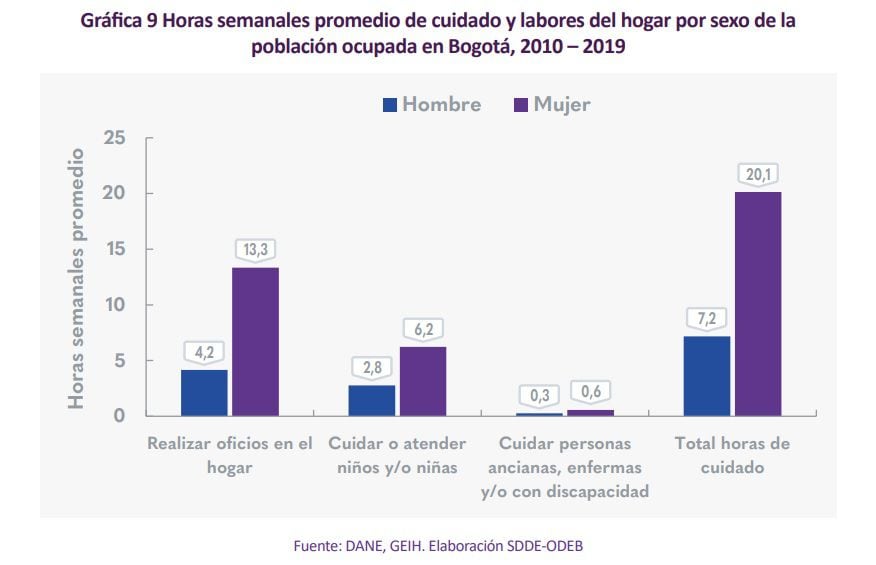
With regard to these figures, the study noted that such overload on unpaid work also represents “an obstacle to women's economic autonomy”, especially in the “availability of time to train, access the labour market, develop personally and professionally, participate in social life and politics, among others”.
According to the research, due to family responsibilities, 40 out of every 100 women in the country's capital have stopped working or seeking employment, while, out of every 100 men in the city, only 3 left their jobs for the same reason.
On the other hand, the Economic Development Observatory also highlighted the gap in the labor market between men and women in relation to the level of employment of each one. According to the analysis, a total of 1,106,395 jobs were lost during the pandemic in Bogotá, of which 54% affected only women in the capital.
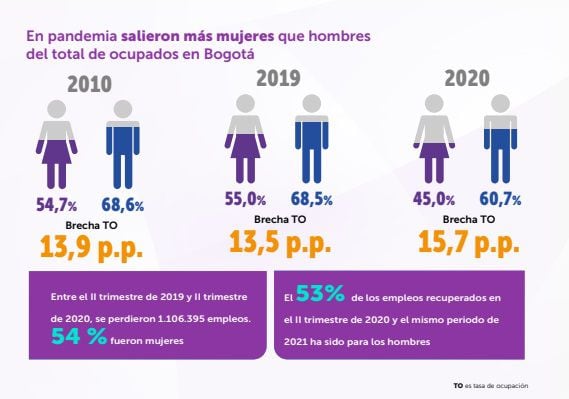
In addition, the study revealed that, between 2010 and 2020, out of every 100 women who were of working age, only 35 per cent were in the labor force, that is, while the labour market participation rate for women was 64.5 per cent, for men it was 77.4 per cent.
The entity added that, although women are increasingly prepared to take an active part in the labor market, their participation in it has not increased. In fact, according to research, since 2010 the female population of Bogotá has been more engaged in informality than men.
“During the decade, the average informality rate for women was 46.3% and that of men 41.3%, with an average gap of 5.1 p.p.,” said the Observatory.
Faced with the panorama, both the Ministry of Economic Development and its Observatory reiterated the need for women's employability in Bogotá, since the report made it clear that in the last decade there have been no significant changes in the matter in the city, despite the fact that women represent 52.8% of the population of working age in the country's capital.
KEEP READING
Últimas Noticias
Debanhi Escobar: they secured the motel where she was found lifeless in a cistern
Members of the Specialized Prosecutor's Office in Nuevo León secured the Nueva Castilla Motel as part of the investigations into the case

The oldest person in the world died at the age of 119
Kane Tanaka lived in Japan. She was born six months earlier than George Orwell, the same year that the Wright brothers first flew, and Marie Curie became the first woman to win a Nobel Prize

Macabre find in CDMX: they left a body bagged and tied in a taxi
The body was left in the back seats of the car. It was covered with black bags and tied with industrial tape

The eagles of America will face Manchester City in a duel of legends. Here are the details
The top Mexican football champion will play a match with Pep Guardiola's squad in the Lone Star Cup

Why is it good to bring dogs out to know the world when they are puppies
A so-called protection against the spread of diseases threatens the integral development of dogs


