


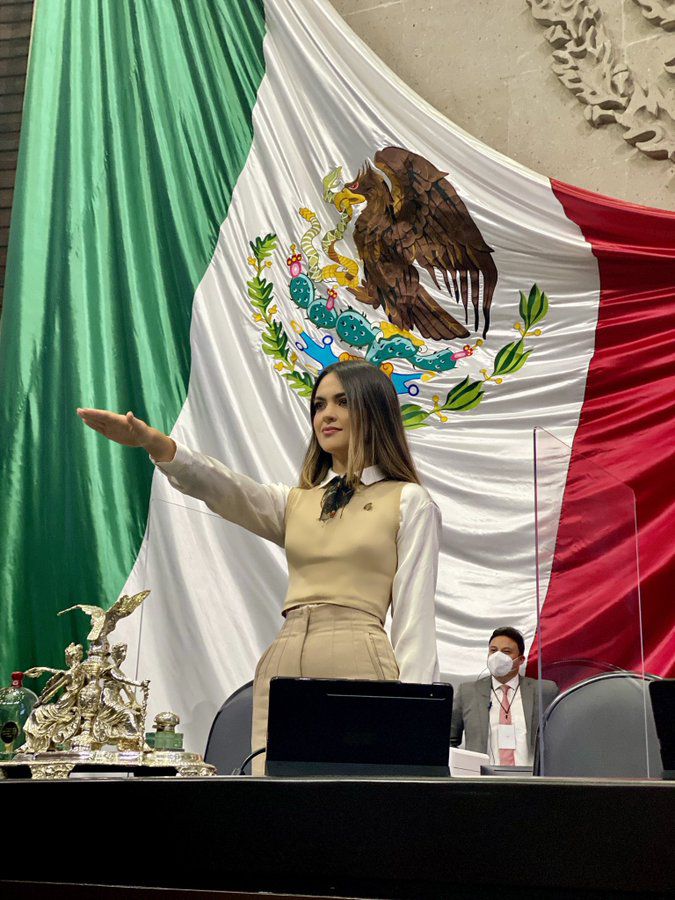
The plenary session of the Chamber of Deputies celebrated with a minute of applause that, for the first time in parliamentary history in Mexico, there are more female legislators than men.
Currently, according to the count, there are 251 women deputies and 249 men. The LXV Legislature, which began in September last year, kicked off with a 50 percent parity.
It was Andrea Chávez Teviño, a deputy for the National Regeneration Movement (Morena), who requested the minute of applause for this historic event.
“For the first time in Mexico's history, we are more federal legislators than legislators, a historic victory for all women in Mexico. Thanks to the victory of parity and thanks to Morena's parliamentary group that has more women members,” said Chávez Treviño during his participation on Wednesday, March 23.
This happened after Julio César Moreno, a deputy of the cherry party, applied for leave on March 15, for an indefinite period. That same day, Elena Edith Segura Trejo joined the ranks of Morena's bench.
In this way, Morena has 105 women deputies and 97 deputies; the National Action Party (PAN), 56 women and 57 men; the Institutional Revolutionary (PRI), 35 women and 36 men; the Green Ecologist of Mexico (PVEM), 19 women and 23 men; the PT, 16 women legislators and 17 legislators; the Democratic Revolution (PRD) 8 women and seven men.
While the Citizen Movement (MC) bench has a parity of 50%. 12 women deputies and 12 deputies
However, that same day, PRI MP Laura Barrera Fortoul accused legislators of not complying with gender parity by adding proposals to the budget. “The truth is that it is very regrettable that in this Legislature, in this first session, and in the second session, we are not fairly reflecting needs in a parity condition without a party, an agenda has been built through the gender equality committee, we are invited to all the deputies, there are speakers, there are initiatives, but when it comes to visibility these initiatives in budget are still totally limited.”
According to the Mexican Institute for Competitiveness (IMCO) in 2021, the wage gap was 13%, that is, for every 100 pesos a man received on average for his work per month, a woman received 87. Similarly, women spent 2.6 times more time than men in unpaid care work.
However, the National Institute of Statistics and Geography (INEGI) reported that, in the same year, 22.8% of women reported having faced sexual intimidation, compared with 5.8% in men.
Motherhood is also one of the factors that accentuate the gender gap, since in addition to meeting their respective working hours, millions of women have to find time to care for their children, a situation that is even more dazzling in the case of single mothers.
The 2020 Population and Housing Census of the National Institute of Statistics and Geography (INEGI) detailed that 72.3% of women aged 15 and over residing in our country, have had at least one daughter or son and of them 7% are single mothers. Similarly, the economic participation rate of single mothers is 75.2%.
KEEP READING:
Últimas Noticias
Debanhi Escobar: they secured the motel where she was found lifeless in a cistern
Members of the Specialized Prosecutor's Office in Nuevo León secured the Nueva Castilla Motel as part of the investigations into the case

The oldest person in the world died at the age of 119
Kane Tanaka lived in Japan. She was born six months earlier than George Orwell, the same year that the Wright brothers first flew, and Marie Curie became the first woman to win a Nobel Prize

Macabre find in CDMX: they left a body bagged and tied in a taxi
The body was left in the back seats of the car. It was covered with black bags and tied with industrial tape

The eagles of America will face Manchester City in a duel of legends. Here are the details
The top Mexican football champion will play a match with Pep Guardiola's squad in the Lone Star Cup

Why is it good to bring dogs out to know the world when they are puppies
A so-called protection against the spread of diseases threatens the integral development of dogs


