


The Federal Police arrested today in raids carried out in the city of Buenos Aires and in the Buenos Aires suburban area five people accused of participating in the attack in November last year with Molotov bombs on the Clarín newspaper building, at 1700 Piedras Street, in the Buenos Aires neighborhood of Barracas.
Official sources reported that the arrests were ordered by federal judge Luis Rodríguez and carried out by the Department of Anti-Terrorism Investigation Unit of the Federal Police. The new detainees join another who is already being tried and sent to oral and public trial.
The procedures were carried out in seven homes, six homes in the western area of the Buenos Aires district and one in the Federal Capital. Five people were arrested there, three men - one with a request for arrest - and two women. All were charged with the crime of public intimidation and will be investigated. They are all Argentinian and of legal age.
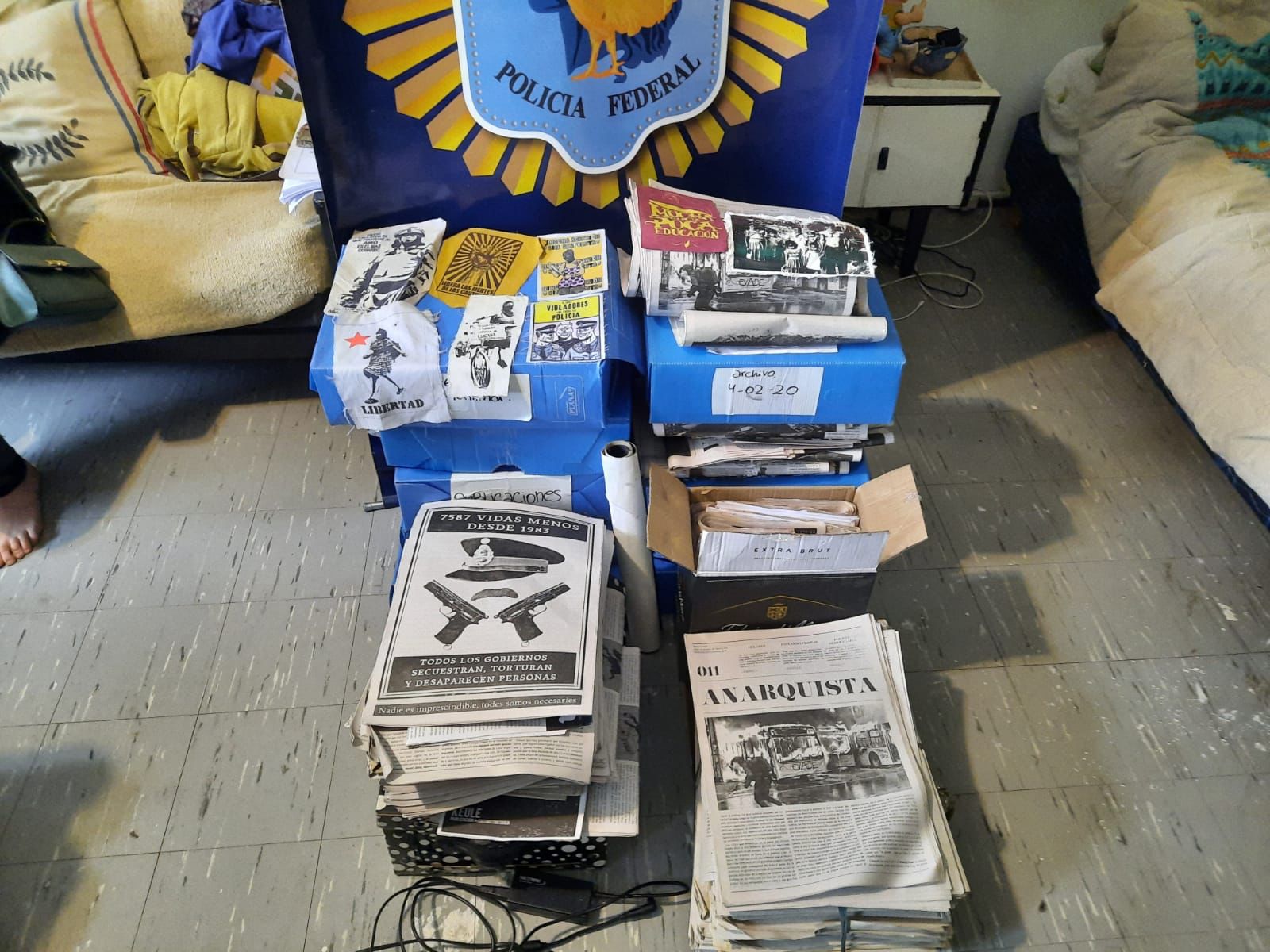
During the raids, flags, bibliographic and propaganda material related to anarchist ideology were hijacked. The hypothesis is that the attack occurred by people related to those groups. Among that material was a poster that read “Freedom to Juan Apud”. Apud is one of those already arrested by the case. He had been arrested last December after being identified by a SUBE card, which Judge Rodríguez sent to oral and public trial in early February. The trial was handled by the Federal Oral Court 5.
Elements were also hijacked to make stencil graffiti, several empty glass bottles, turpentine, four notebooks, three CPUs, a motorcycle, a cannabis sativa plant and 29 cell phones. All technological material will be valued.
On the night of Monday, November 22, in Piedras Street at 1700, in the neighborhood of Barracas, a group of nine people arrived at the door of the Clarín newspaper and dropped between seven and eight firebombs from the opposite sidewalk. The sequence was recorded on security cameras and a judicial investigation was launched. Of the nine people, six were men and three women.
The main tool for the researchers was security cameras in the area. They were analyzed to follow the route that the attackers took both to get to the place and to leave the area of the Clarín newspaper building.
Through these images, Apud began to be reached. In one of the cameras it was observed that 12 minutes after the event a motorcycle with two of the attackers stopped at the corner of Montes de Oca and Brandsen and one of them took a bus from line 60. The researchers analyzed the SUBE transport cards and observed that at that time the only card used was in the name of a woman. They analyzed their social networks and found photos on Facebook with their partner, Apud, who corresponded to the face of the images on the security cameras.
The case had a first detainee who was later released. This was Martin Michel Gallarreta Albin, who had been arrested on 2 December. Investigators believed that the one on the motorcycle was Albin and not Apud. But when he was arrested and with the evidence against him, Albin was already released.
The attack on the Clarín Group building generated widespread rejection that initially arose from opposition referents, who were later joined by leaders of the national government and La Campora.
“I want to express our repudiation of the episode that took place in front of the Clarín newspaper headquarters. Violence always alters democratic coexistence. We hope that the facts will be clarified and the authors will be identified based on the ongoing investigation,” President Alberto Fernández posted on social networks.
I KEPT READING:
Últimas Noticias
Debanhi Escobar: they secured the motel where she was found lifeless in a cistern
Members of the Specialized Prosecutor's Office in Nuevo León secured the Nueva Castilla Motel as part of the investigations into the case

The oldest person in the world died at the age of 119
Kane Tanaka lived in Japan. She was born six months earlier than George Orwell, the same year that the Wright brothers first flew, and Marie Curie became the first woman to win a Nobel Prize

Macabre find in CDMX: they left a body bagged and tied in a taxi
The body was left in the back seats of the car. It was covered with black bags and tied with industrial tape

The eagles of America will face Manchester City in a duel of legends. Here are the details
The top Mexican football champion will play a match with Pep Guardiola's squad in the Lone Star Cup

Why is it good to bring dogs out to know the world when they are puppies
A so-called protection against the spread of diseases threatens the integral development of dogs


