


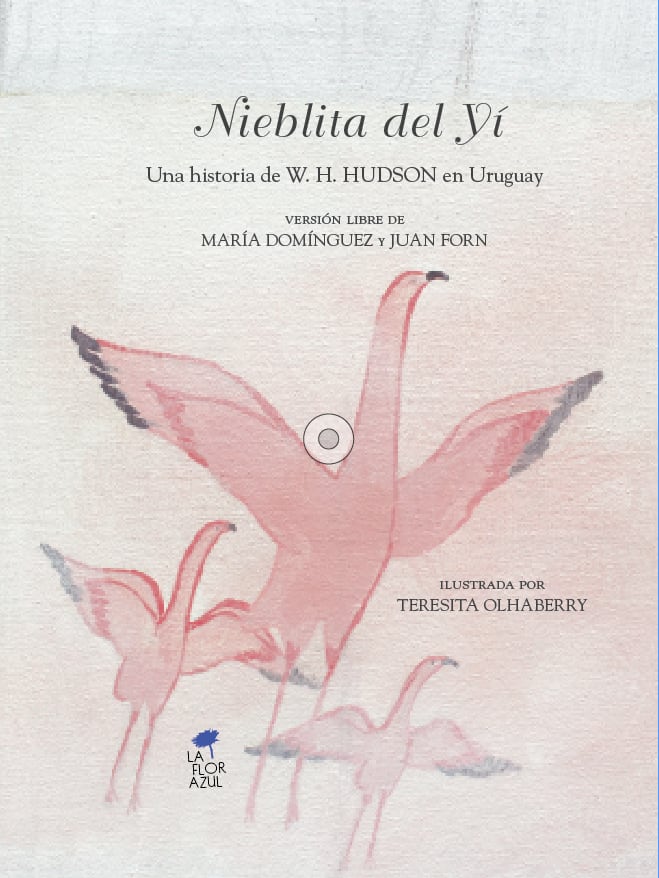
Just a few days after Juan Forn died, the departure of Nieblita del Yi, a book written by him and his partner Maria Domínguez, was announced, based on a story by Guillermo Enrique Hudson and illustrated by Teresita Olhaberry. The postmortem publication can only indicate one question, if it refers to Forn — that person so dear to all who knew him and who possessed an incredible passion for texts and writing —: his relationship with literature survives everything, even death.
Hudson is a 19th century author who was born in Argentina, more precisely, in Quilmes, to English parents. At the age of 33, for health reasons, he emigrated to Britain and began a prolific writing career with a work based on his memoirs, mainly in Argentina, although he was also a fanatic ornithologist, founder of the Bird Protection Society in England and honorary president of the Silver Honorary Society. Far away and long ago and The Purple Land are perhaps his most powerful works about his stay in the country.
Infobae Cultura talked with María Domínguez about Nieblita del Yi, a book in which several literatures are condensed.
How did it occur to you that a fragment of Hudson, an author who is usually studied in college or the last years of high school, could be the subject of a children's literature book?
—The idea of turning that fragment into a book, or rather, that story that is part of Hudson's novel, took place in the imagination of Pablo Franco and Teresita Olhaberry, the promoters of the Flor Azul publishing house —in addition to Teresita illustrating the pages of the book—during a trip they took to Uruguay, when in a theater of Montevideo witnessed a play based on The Purple Land and were delighted. Pablo says that the next day they searched endlessly, until they found it, an edition of the novel translated by Idea Vilariño. Many years later, in Mar Azul and when they already had the publishing house in hand, during a visit we made with Juan to his house, they talked to us about the idea of the book and showed us the story. Then a new enchantment took place. I don't quite remember what it was like, but Pablo maintains that I proposed to Juan, and he agreed, to make together a free version of the story that Tere was already beginning to illustrate. I like to think that Nieblita del Yí is the materialization of a succession of charms.
On the other hand, I'm not so sure it's just a children's literature book. I think that Nieblita can be part of the legion of ageless books, those that contain different layers of meaning, as if they were a kind of Chinese box, or a mamushka.
—Forn had not published before in this genre, I don't know if you did. How did you perceive his discovery of the genre as an author?
“While we were doing Nieblita, there were moments of great fun and tenderness, there were also some debates, but I doubt that for Juan it meant the discovery of a genre as an author. On the one hand, he disbelieved the gender category quite a lot and was always looking to blur the borders. To write, he stopped on what he called the amphibian, and which represented a kind of escape route, a way to free himself from the vest of literary classifications. On the other hand, during the writing process I saw him activate the same mechanism that he used for his back covers. Juan understood stories, stories, as perfect transmission artifacts, the place where communication occurs most spontaneously. Thousands of times I heard him say: “what interests me is telling the story”, and that is exactly what happens in Nieblita del Yí, we tell a story. I think the new thing in this case could have been the experience of writing with someone else: deciding in two ways which words to use, how to engage in dialogue between two characters, how to show the meaning of the story, how to write the ending.
In the back covers, Juan established a mental dialogue with the writers he read, but it was finally he who decided how to tell. In Nieblita del Yí something else happens, because it is the result of a superposition and a communion of voices that gave shape and meaning to the story. We can think that Hudson is there first, Idea Vilariño later, then Juan's voice and mine appear together, and in parallel they merge with Tere's paintings, where a free illustrated version of the story also took place. It was she who transformed Nieblita into a bird. When Juan and I saw the black beak sticking out over his head, we had to go back to the text and write it in a different way.
— What was it like to work with four hands?
—More than four hands worked on this book: while Pablo was looking for the ideal format and roles, he was also busy preparing the way for transformation into a book, Tere painted to exhaustion on huge canvases, Juan and I wrote and Ana Armendariz acted like a kind of genius designer who distance was in charge of merging everything we were doing. I think that all that collective task, that shared doing, and the time of maceration that the book had, is what ultimately gives the book so much value and beauty. We spent four years doing it, we had the time in our favor. We work without hurry, without conditioning, among friends. Juan always said that if you pay attention, a story tells you how it wants to be told. I think that's what we did, take the time to listen and realize how we had to tell that story.
Now that the book is in the hands of many people, the story begins to expand and new things appear. Yesterday someone told me that in China, in the Yellow River basin, there is also a huge river called Yí, but that there is a scholar of etymology who claims that the name of the Uruguayan river derives from Guaraní and can be translated as a mighty river, a river that is not cut off.
KEEP READING
Últimas Noticias
Debanhi Escobar: they secured the motel where she was found lifeless in a cistern
Members of the Specialized Prosecutor's Office in Nuevo León secured the Nueva Castilla Motel as part of the investigations into the case

The oldest person in the world died at the age of 119
Kane Tanaka lived in Japan. She was born six months earlier than George Orwell, the same year that the Wright brothers first flew, and Marie Curie became the first woman to win a Nobel Prize

Macabre find in CDMX: they left a body bagged and tied in a taxi
The body was left in the back seats of the car. It was covered with black bags and tied with industrial tape

The eagles of America will face Manchester City in a duel of legends. Here are the details
The top Mexican football champion will play a match with Pep Guardiola's squad in the Lone Star Cup

Why is it good to bring dogs out to know the world when they are puppies
A so-called protection against the spread of diseases threatens the integral development of dogs


