

“The ten massacres documented here were perpetrated directly by paramilitary groups, but they were made possible by the support by action and omission provided by the members of the Third Division and in turn Artillery Battalion No. 3 Battle of Palacé, Engineering Battalion No. 3 Agustín Codazzi, and Infantry Battalion No. 8 Battle of Pichincha, members of the Third Brigade of the National Army”, begins the report “Whistles of Horror”, prepared by the José Alvear Restrepo (CAJAR) Lawyers' Collective and which was presented on March 30 to the Special Jurisdiction for Peace (JEP).
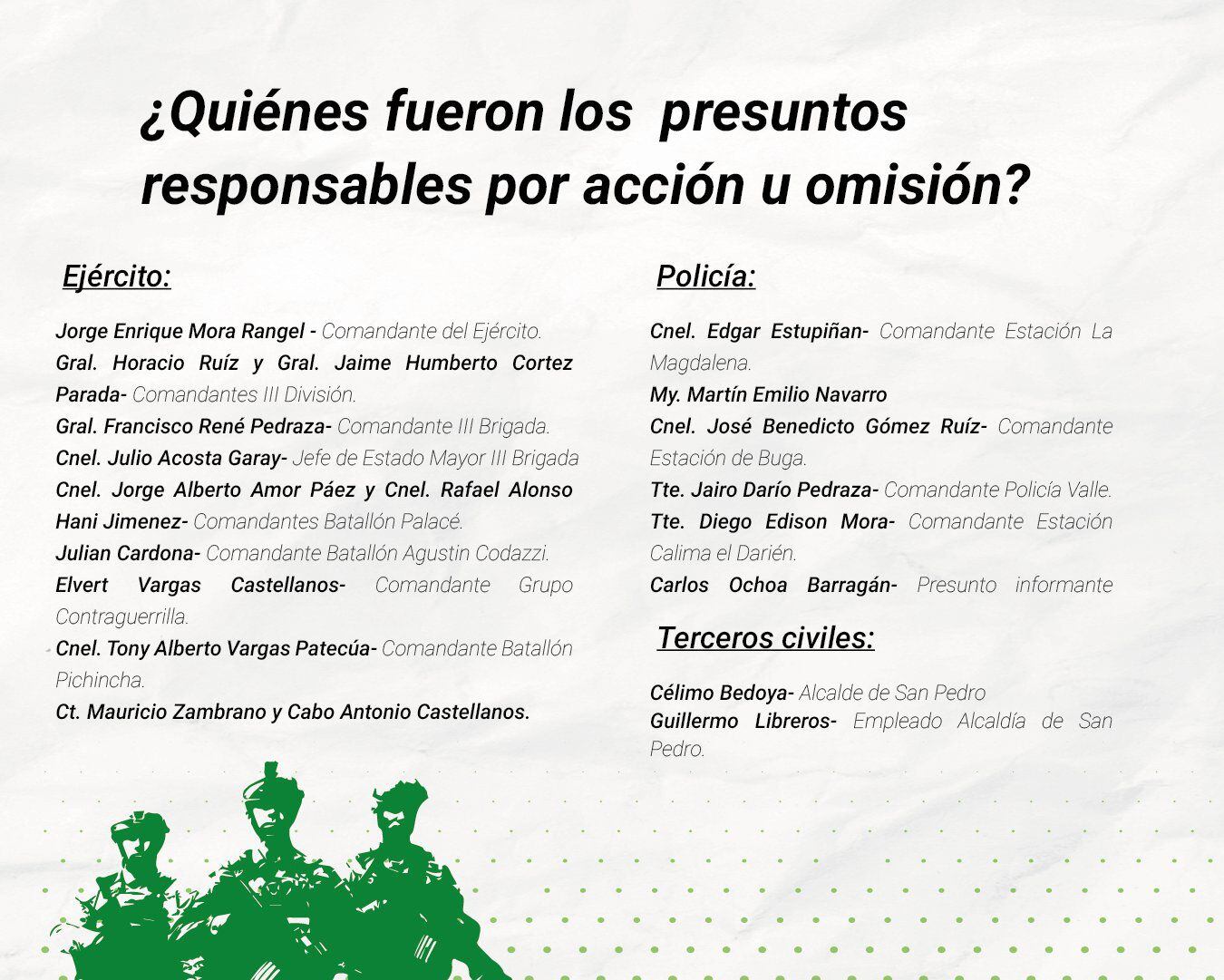
The events involving 12 senior commanders of the National Army, six officers of the National Police and two third civilians (see photo 1), occurred in the center of Valle del Cauca and northern Cauca between 1999 and 2001 and left 93 victims. For these events, only members of the paramilitary structures that directly carried out the massacres have been condemned before Justice and Peace.
The investigation indicates that from the identification of each of the massacres (see photo 2), it was possible to establish that eight of the 10 were committed through paramilitary incursions of up to 85 armed men in the vicinity of the jurisdiction of military units of the National Army. The Calima Bloc of the United Self-Defense Forces of Colombia was the paramilitary group to which each of these attacks was attributed to the civilian population.
One of the requests of this report is that the jurisdiction of peace call voluntary versions to the State agents of the security forces and related third parties, identified by the material actors of the massacres. The document would demonstrate a policy on the part of the Colombian State in which the security forces played a fundamental role in the formation and consolidation of the Calima Block.
Among the findings they presented to the transitional justice system, it would be demonstrated that the victimizing events were mainly directed at the peasant movements and indigenous communities, many of them organized in the Cauca Regional Indigenous Council (CRIC), which were significantly weakened as a result of this systematic violence.
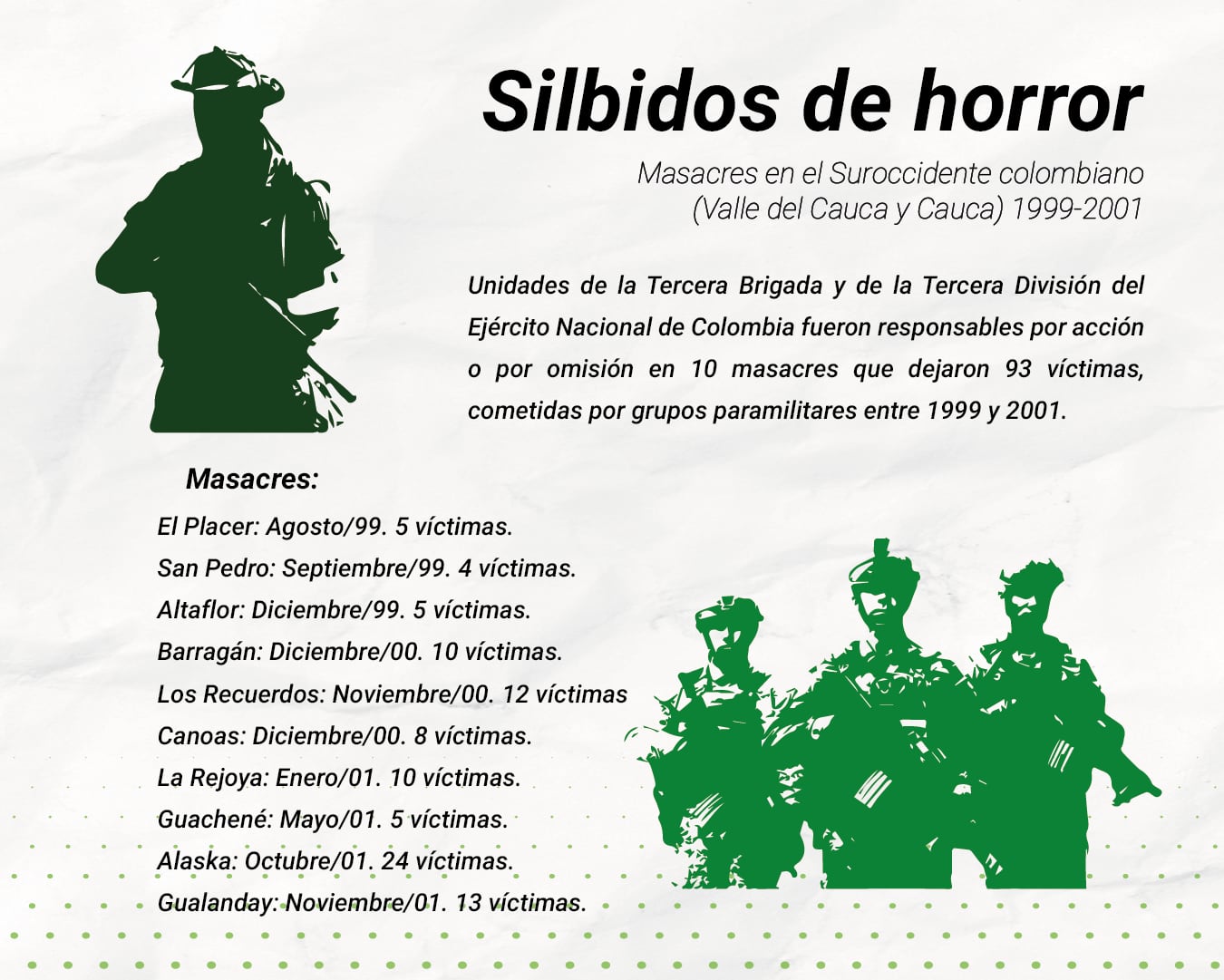
Another coincidence of these massacres was the null reaction of the civil and police authorities to the arrival and settlement of the paramilitaries, in each of the places where they arrived. With the people at their disposal, the armed men burned houses, looted businesses, murdered and shot innocent people and many more had to leave their places threatened. The report states that the massacres were aimed at the displacement and dispossession of territories.
At the time of the events, the national authorities were dedicated to denying the existence of paramilitary groups and were not taking any action against them. “There was a modus operandi that functioned as a sobering mechanism for the civilian population and, in turn, allowed the paramilitary project to be positioned, obtaining benefits for different actors, including state agents of different nature and third civilians, including economic actors,” said El Cajar in “Whistles of Horror ”.
In the two events other than incursion, the criminal group carried out the massacre by setting checkpoints on the road. This was the case of the massacres in La Rejoya and Gualanday. In both cases, it would be concluded that the paramilitaries of the Calima Block used guides or informants, possibly provided by the security forces.
Another request submitted to the jurisdiction arising from the Peace Agreement between the Colombian State and the former FARC guerrillas is the accreditation and recognition as victims of the relatives of the murdered persons, such as those who were disappeared and forcibly displaced or victims of other types of crimes, “and to implement all protection and security measures to which there may be”.
KEEP READING:
Últimas Noticias
Debanhi Escobar: they secured the motel where she was found lifeless in a cistern
Members of the Specialized Prosecutor's Office in Nuevo León secured the Nueva Castilla Motel as part of the investigations into the case

The oldest person in the world died at the age of 119
Kane Tanaka lived in Japan. She was born six months earlier than George Orwell, the same year that the Wright brothers first flew, and Marie Curie became the first woman to win a Nobel Prize

Macabre find in CDMX: they left a body bagged and tied in a taxi
The body was left in the back seats of the car. It was covered with black bags and tied with industrial tape

The eagles of America will face Manchester City in a duel of legends. Here are the details
The top Mexican football champion will play a match with Pep Guardiola's squad in the Lone Star Cup

Why is it good to bring dogs out to know the world when they are puppies
A so-called protection against the spread of diseases threatens the integral development of dogs


