


“History rules: it's very difficult to be electorally competitive with so much inflation.” Under that slogan, a Consultatio report released last Friday demonstrated how the widespread and sustained sharp rise in prices in Argentina is “incompatible” with any chance of electoral success.
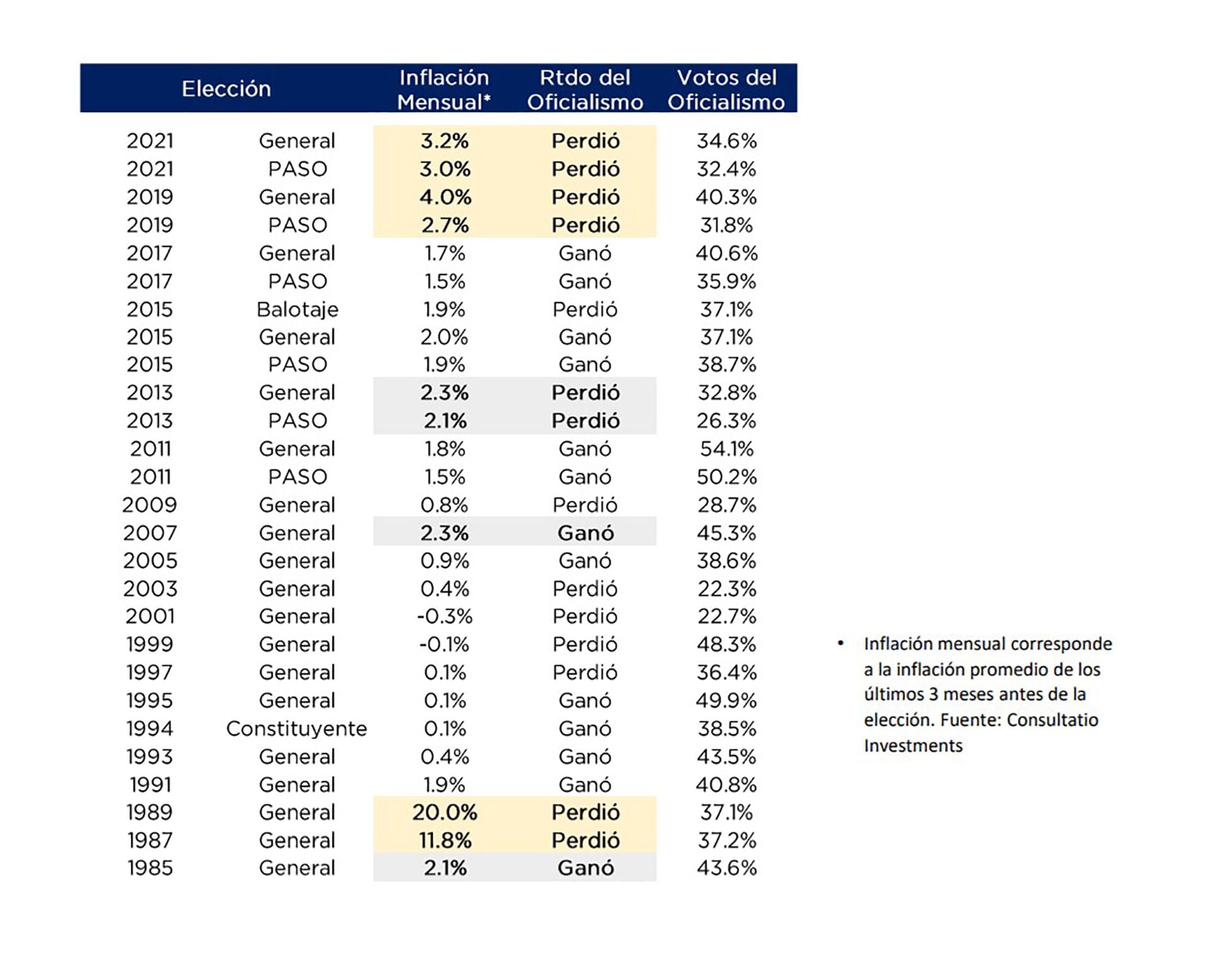
Along these lines, the consultancy specified what the average inflation was in the last three months prior to the elections, from 1985 to 2021, and what percentage of votes the ruling party won each year.
“The tensions publicly evidenced by the ruling coalition in recent days reflect different interpretations of the same phenomenon: the current macro dynamic leads to a resounding electoral defeat in 2023,” the study noted.
According to experts, the internal breakdown does not occur because of the forecast - which is shared - but because of a different interpretation of its determinants: for the wing led by Vice-President Cristina Kirchner, the key factor is “the adjustment” that will ensue the agreement with the International Monetary Fund (IMF) and therefore proposes not sign the agreement.
“For the President, on the other hand, the problem is not that (the alternative would be worse) but the dynamics that inflation acquired: history shows that these levels of inflation are incompatible with any chance of electoral success. And that is why he is launching a 'war against inflation, '” they said.
It should be recalled that last week, when he led an event in the Buenos Aires party of Malvinas Argentinas, the head of state Alberto Fernández said: “I hope that this week we can begin to bring order to the issue of the tremendous debt we inherit. And on Friday the war against inflation begins in Argentina; we are going to end the speculators.”
According to Consultatio, historically, the ruling victory that had the highest inflation was that of Cristina Fernández de Kirchner in 2007. In that year it won 45% of the votes with an average of 2.3% per month in the three months prior to the election.

If you look ahead, “it's hard to believe that in the months leading up to the 2023 elections we can have inflation of less than 3.5% per month,” the experts predicted. According to his analysis, with 55%, 65% expected for this year and the difficulties that “deflation” entails and implies, one can imagine an “average monthly floor of 2023 close to 3.5% (it would be 50% annualized)”.
At the other extreme, they argued, 4.5% per month (70% annualized) could be perceived as a reasonable ceiling assuming that the crisis can be avoided: “In this context, the range of 3.5% to 4.5%, makes it difficult to think of a competitive ruling for 2023″.
Central points of the study
Among the main conclusions of the report, Consultatio highlighted that the February inflation figure of 4.7% put at the center of the scene an element that they insisted on more than once: “The program agreed with the IMF is not only not designed to attack inflation, but depends on it as an adjustment variable”.
“Historically, inflation records like the current ones always anticipated electoral defeats, which explains the growing tensions within the ruling coalition, which we hope will continue to worsen in the coming months,” they warned.
On that axis, they stressed that “historical evidence shows that price controls have never been effective on their own.” And added to this, they added that “poor implementation carries serious risks of worsening the situation.”
By way of closure, the specialists said that the anti-inflation plan to be implemented faces a strong dilemma. The development of a program that effectively reduces inflation, which in itself is challenging, “would greatly complicate the fiscal front and force an adjustment to compensate for it or break with the IMF,” they concluded.
KEEP READING:
Últimas Noticias
Debanhi Escobar: they secured the motel where she was found lifeless in a cistern
Members of the Specialized Prosecutor's Office in Nuevo León secured the Nueva Castilla Motel as part of the investigations into the case

The oldest person in the world died at the age of 119
Kane Tanaka lived in Japan. She was born six months earlier than George Orwell, the same year that the Wright brothers first flew, and Marie Curie became the first woman to win a Nobel Prize

Macabre find in CDMX: they left a body bagged and tied in a taxi
The body was left in the back seats of the car. It was covered with black bags and tied with industrial tape

The eagles of America will face Manchester City in a duel of legends. Here are the details
The top Mexican football champion will play a match with Pep Guardiola's squad in the Lone Star Cup

Why is it good to bring dogs out to know the world when they are puppies
A so-called protection against the spread of diseases threatens the integral development of dogs


