


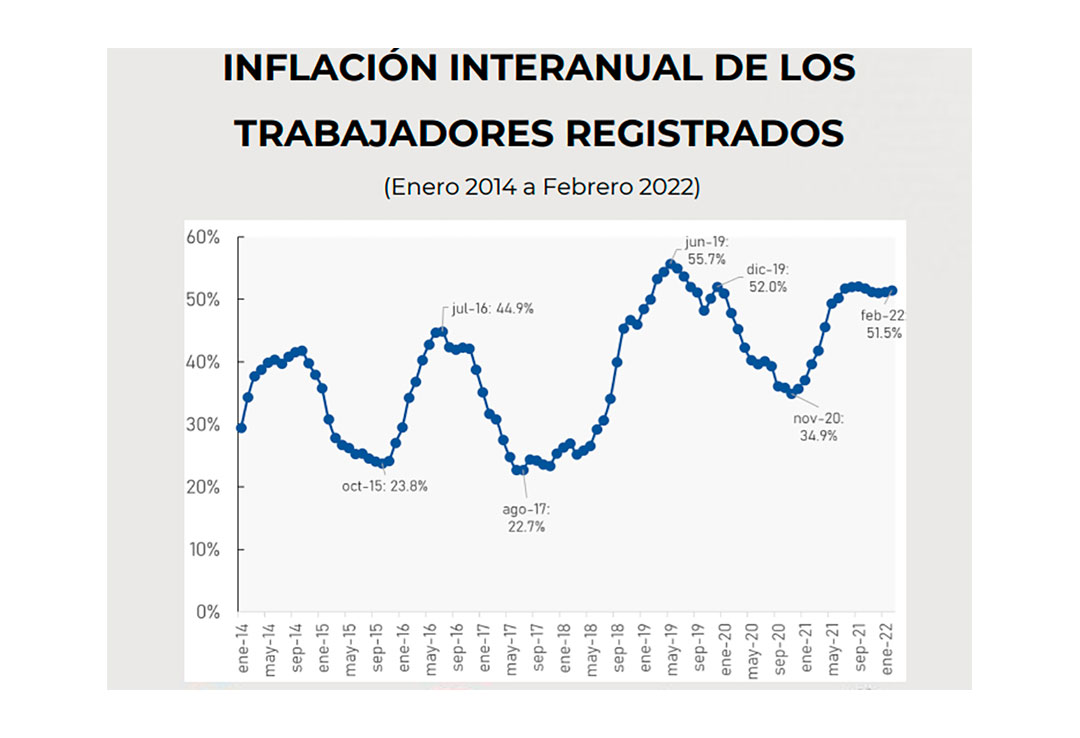
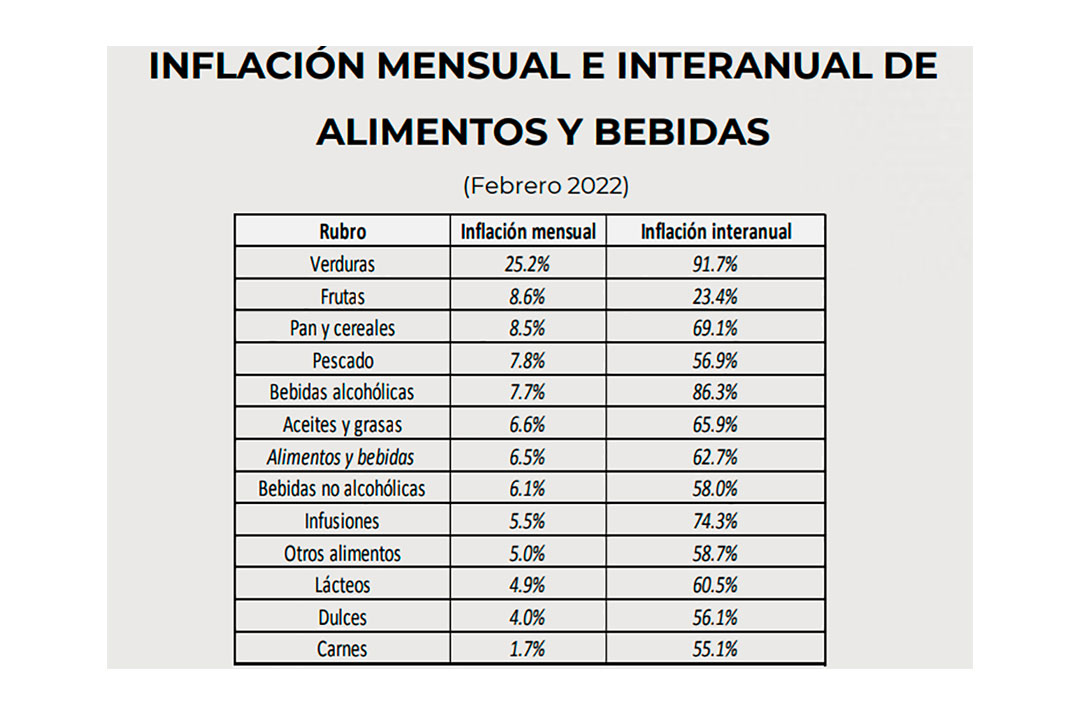
The “worker inflation” reported by the Statistical Institute for Workers (EIT) of the Metropolitan University for Education and Work (UMET) grew by 4.3% in February, a tenth above 4.2% in January, with an increase of 51.5% compared to the same month last year. But the most striking figure in the report was the 6.5% increase in the “Food and Beverage” category, with a sharp spike in the price of vegetables of 25.2% in the month and 91.7% in the year-on-year calculation. The study reflects the evolution of the cost of living in those households where the head of household is a registered employee.
“February inflation was driven by Food and Beverage, which rose 6.5% after doing so by 5.8% in January. There was a particular spike in vegetables (+25.2%), which was recorded in a variety of products, such as onions, carrots, potatoes or tomatoes, among others. Fruits rose 8.6%, with orange and banana standing out,” the report detailed.
Bread and cereals increased by 8.5% (69.1% year-on-year). In particular, French bread increased by 12.5% and wheat flour by 5.1%. In this regard, UMET stressed that February prices practically do not reflect inflationary pressures resulting from the Russian invasion of Ukraine, which triggered the international price of wheat and other raw materials since the end of February.
Fish (+7.8%), alcoholic beverages (+7.7%) and oils and fats (+6.6%) also had a particularly inflationary February. Only meat (+1.7%) allowed to cushion the strong increases recorded in the month.
“The second division with the highest increases was Home Equipment and Maintenance, with 4.3%, with notable increases in hygiene and cleaning products. It is followed in order Health, which climbed an additional 4%, Other goods and services (+3.9%), Communications (+3.9%), Transport (+3.5%, there was gasoline surge) and Recreation and culture (+3.1%). Only Housing (+2.6%), Education (1.6%) and Clothing and Footwear (+1.1%) recorded increases below 3%,” the report concluded.
Activity and employment
The UMET report also addresses the situation of activity, employment and real wages. In this regard, he emphasized that at the end of 2021, at the same time as high inflation, there was “a clear economic upturn and, more moderately, in employment and wages. At the end of 2021, economic activity reached the highest level since March 2018, underpinned by industry, but also by the recovery of construction, hydrocarbons in Vaca Muerta, trade and some services such as computer science.”
Finally, the report concludes that the recovery in economic activity had a direct impact on that of private formal wage employment, which in December 2021 returned to February 2020 levels and even exceeded them by 10,000 jobs: “While this is good news, it should be borne in mind that the population aged employment grows at a rate of approximately 1% per year; in this way, returning to the same formal employment of the pre-pandemic but with a larger population implies a deterioration in socio-labor terms”.
“Although in recent months employment has grown above population growth, it is still missing to return to February 2020 levels, which, by the way, were at a very low level in historical terms,” added the study, which noted that formal private wage employment “per capita” is better than in 2020 but very below the 2009-2019 average.
KEEP READING:
Últimas Noticias
Debanhi Escobar: they secured the motel where she was found lifeless in a cistern
Members of the Specialized Prosecutor's Office in Nuevo León secured the Nueva Castilla Motel as part of the investigations into the case

The oldest person in the world died at the age of 119
Kane Tanaka lived in Japan. She was born six months earlier than George Orwell, the same year that the Wright brothers first flew, and Marie Curie became the first woman to win a Nobel Prize

Macabre find in CDMX: they left a body bagged and tied in a taxi
The body was left in the back seats of the car. It was covered with black bags and tied with industrial tape

The eagles of America will face Manchester City in a duel of legends. Here are the details
The top Mexican football champion will play a match with Pep Guardiola's squad in the Lone Star Cup

Why is it good to bring dogs out to know the world when they are puppies
A so-called protection against the spread of diseases threatens the integral development of dogs


