


The Guatemalan Congress closed on Tuesday a controversial law that it had passed a week ago in which it sought to combat abortion and “minority groups” that are “inconsistent with Christian morality.”
The Guatemalan deputies thus reversed their objectives of promoting the law, under pressure from social and international sectors who expressed their opposition in their last days to the new legislation, called the Law for the Protection of Life and the Family.
The controversial new statute against abortion and minorities was approved on March 8 with 102 votes from deputies allied to the Vamos bench, of Guatemalan President Alejandro Giammattei, and eight against (most of the political group Semilla), in addition to 50 absentees.
However, it was Giammattei himself who indicated in a message to the population on March 10 that he would veto the law because it violated the Guatemalan Constitution, in addition to several international treaties.
The decision to close the law was taken on Tuesday with the vote of 119 of the 160 deputies that make up the legislative body of the Central American country, including the vast majority of those who had approved the legislation on March 8.
Deputy Bernardo Arévalo, from the opposition political group Semilla, assured this Tuesday before the plenary session of the Parliament that “shame will not pass quickly” for the legislators who initially approved the law.

“Shame is known to the people of Guatemala, who know who voted against it and know who approved a text that was unconstitutional and that leads the president to ask for it to be shelved,” said Arévalo, whose group was born out of the fight against corruption in Guatemala in 2015.
THE ARCHIVED LAW
Initiative 5272, initially proposed in 2017 by the conservative Viva party until its approval on March 8, increased prison sentences for women who have abortions, originally set from 1 to 3 years in prison and now amended with sentences of up to 5 years in prison at least and up to 50 years in some cases.
Similarly, the regulations prohibited teaching sexual diversity in educational institutions.
Congress asserted on March 8 that the law should be passed “considering” the “existence of minority groups in society, which propose currents of thought and practices inconsistent with Christian morality.”
Although Giammattei said on March 10 that he would veto the new statute, legal experts on the subject insisted that there was a possibility that Congress would pass the law without the president's vote of support, as established by the Guatemalan Constitution.
However, the deputies finally reversed the regulations on Tuesday, decreed the day before Guatemala was designated by a Christian congress as the “Ibero-American Capital Pro-Life”.
Giammattei and the President of the Congress, Shirley Rivera, were attended by Giammattei and the President of the Congress, Shirley Rivera.
“What would happen if we joined together? Today this event is an invitation to unite in protecting life from conception to natural death in its five stages,” said the Guatemalan president during his speech at the event.
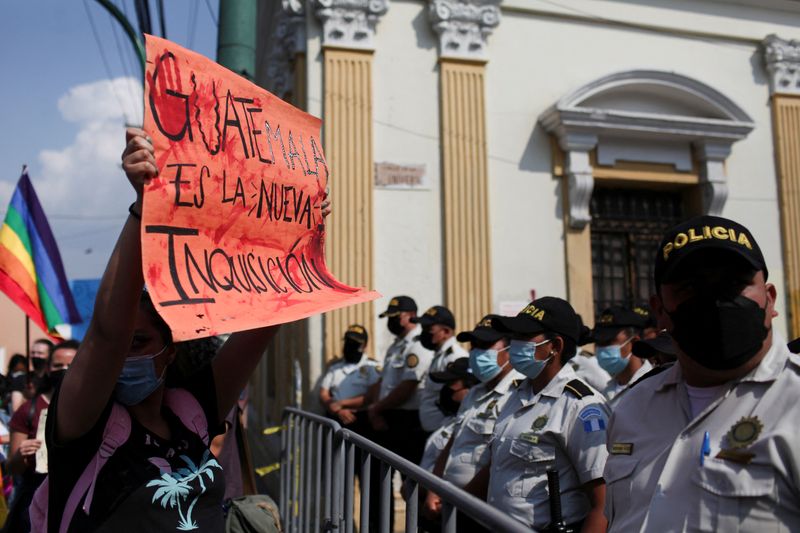
Around a hundred people appeared outside the Guatemalan Congress, in the capital of the country, to expose their disagreement with the new law and celebrated its archiving.
The humanitarian organization Amnesty International had indicated last week through the Americas Director, Erika Guevara Rosas, that the regulations passed by the Guatemalan Congress encouraged “hatred and discrimination” and did not protect “families or lives.”
(With information from EFE)
KEEP READING:
Últimas Noticias
Debanhi Escobar: they secured the motel where she was found lifeless in a cistern
Members of the Specialized Prosecutor's Office in Nuevo León secured the Nueva Castilla Motel as part of the investigations into the case

The oldest person in the world died at the age of 119
Kane Tanaka lived in Japan. She was born six months earlier than George Orwell, the same year that the Wright brothers first flew, and Marie Curie became the first woman to win a Nobel Prize

Macabre find in CDMX: they left a body bagged and tied in a taxi
The body was left in the back seats of the car. It was covered with black bags and tied with industrial tape

The eagles of America will face Manchester City in a duel of legends. Here are the details
The top Mexican football champion will play a match with Pep Guardiola's squad in the Lone Star Cup

Why is it good to bring dogs out to know the world when they are puppies
A so-called protection against the spread of diseases threatens the integral development of dogs


