


The Chechens have earned their reputation as fierce warriors since the two wars they fought with Russia, the first from 1994 to 1996 and the second from 1999 to 2014. This is the most violent conflict in Europe and the former USSR since the Second World War.
These warriors are currently present in Ukraine on both sides of the front. Chechens who have fled to Ukraine since the wars that ravaged their country support the Ukrainian armed forces. Their participation has gone almost unnoticed. However, the hype announcement on February 25, 2022, that Ramzan Kadyrov's troops would be sent to Ukraine to fight alongside the Russian army caused a stir in the Western media.
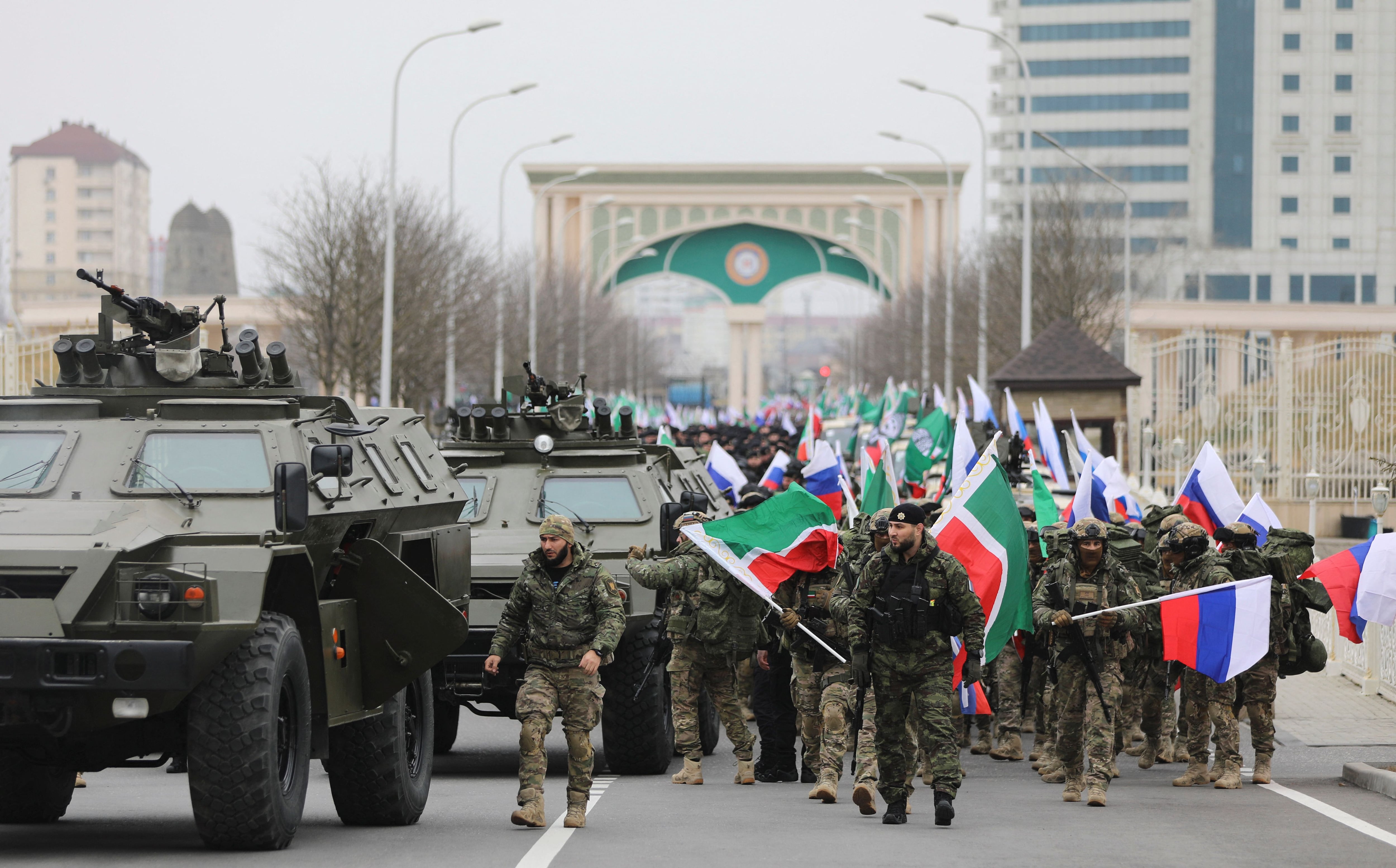
Ramzan Kadyrov, President of the Chechen Republic since 2007, also claims to be present in Ukraine. A faithful follower of Vladimir Putin, he has returned Chechnya to the fold of the Russian Federation using terror as a weapon of government. He leads tens of thousands of men, nicknamed the Kadyrovtsy. No other federated entity of the Russian Federation has such an armed force. Although the Kadyrovtsy are members of the Russian National Guard, they remain under the sole command of President and Major General Kadyrov. How should their involvement in the Russian invasion of Ukraine be interpreted?
As a professor of political science at Laval University, my research focuses on civil wars, especially those in Chechnya, the conflict in the Sahel and political violence.
A psychological weapon
Many analysts believe that Russia's military strategy did not yield the expected results in the first two weeks of the war. The Ukrainian resistance, together with the difficulties of supply, but also with the poor coordination of the different army corps and the problems of motivation between the conscripts and professional soldiers, slowed down considerably the advance of Russian troops. Faced with these military and logistical difficulties, psychological warfare became a central element of Russian strategy.
The announcement of the entry into war of Kadyrov's troops and the propaganda that surrounded him were part of this effort to destabilize the enemy. Thus, the Kadyrovtsy are above all specialists in maintaining order in the conquered cities. They are known for their cruelty and the abuses of which they have been guilty in Chechnya itself, in Donbass in 2014, where they intervened, and in Syria, where some of their troops are still deployed. The invocation of the use of Chechen troops thus serves to fuel fear among the Ukrainian population. Similarly, the rumor that his special forces are charged with killing Ukrainian President Volodymyr Zelensky is intended to maintain uncertainty and create fear.
However, their role may go further, as Moscow sent one of these battalions to Donbass in 2014 to break the pro-Russian separatists and purge them of their most conflicting elements. The presence of Chechen troops thus demonstrates that Moscow is preparing for an urban guerrilla war in Ukraine in which the experience of Kadyrov's troops could be an advantage, not only in overcoming local Ukrainian resistance, but also in disciplining Russian troops and their affiliates.
A rebel who has fallen from grace
Other, more political dimensions directly and indirectly feed Russian propaganda and the psychological warfare it serves.
Ranzam Kadyrov's appearances on Chechen television and on social media serve to recall his loyalty to Vladimir Putin to satiety. If these gestures sometimes touch the caricature, they illustrate the support of a federated subject who was once a rebel and who has now fallen out of favor after two wars of unprecedented violence and the establishment of an authoritarian regime paid by Moscow.
Certainly, the excessive personalization of politics and decision-making in the Federation makes any dissenting voice de facto inaudible, if any. The fact that Kadyrov embodies this image of cohesion is, however, a paradox, since the relationship between Moscow and Chechnya continues to be marked by a form of exceptionalism within the Federation.
Cracks that could widen
On the other hand, Kadyrov's support reminds us that the commitment of the federated subjects behind Vladimir Putin goes beyond ethnic and religious borders, which would be erased by the declared objective of opposing a hated West, while fighting Ukrainian authorities described as “Nazis”.
However, behind this facade of circumstances there are already cracks that will be more difficult to hide if the war is prolonged. In fact, the Kremlin seems to have asked the leaders of the federated subjects to defend the official discourse that makes this war a “special military operation” aimed solely at military objectives. This role as a smokescreen could be complex for most of them when questions begin to arise among the population about the significant losses that the Russian army seems to be suffering.
However, referring to the Russian army without further details tends to obscure its multi-ethnic character. Some experts even consider that non-ethnic Russians (that is, Russian citizens, but of non-Russian origin) are in the majority. Coming from socioeconomically disadvantaged federated entities, they could account for a significant proportion of deaths. This scenario could not be countered by Kadyrov's calls for accelerated intervention in Ukraine. They would even be counterproductive for Vladimir Putin.
The role of the Kadyrovtsy in the conflict in Ukraine is far from one-dimensional. Beyond the terror they inspire, they embody the image of a total commitment of the federated subjects behind the President of the Federation, Vladimir Putin. However, this idyllic landscape could crack under the effects of a longer and tougher war than anticipated. The use of these troops is therefore a risky bet. Their poor integration into the chain of command could diminish the benefits associated with their participation with regular units of the Russian army. In this way, Kadyrov could become a political drag, since his triumphalism seems not to fit the reality of this war.
Article originally published in The Conversation- By Aurélie Campana, Professor of Political Science, specialist in political violence and Russia, Laval University
KEEP READING:
Últimas Noticias
Debanhi Escobar: they secured the motel where she was found lifeless in a cistern
Members of the Specialized Prosecutor's Office in Nuevo León secured the Nueva Castilla Motel as part of the investigations into the case

The oldest person in the world died at the age of 119
Kane Tanaka lived in Japan. She was born six months earlier than George Orwell, the same year that the Wright brothers first flew, and Marie Curie became the first woman to win a Nobel Prize

Macabre find in CDMX: they left a body bagged and tied in a taxi
The body was left in the back seats of the car. It was covered with black bags and tied with industrial tape

The eagles of America will face Manchester City in a duel of legends. Here are the details
The top Mexican football champion will play a match with Pep Guardiola's squad in the Lone Star Cup

Why is it good to bring dogs out to know the world when they are puppies
A so-called protection against the spread of diseases threatens the integral development of dogs


